
Certainty in Excess: Soliloquy, Knowledge, and Mystical Love in Bonaventure and Hugh of St Victor (part 4/4)
Installment #7 in the serial essay, "Presenting the Self: Inner Dialogue and Spiritual Exercise"

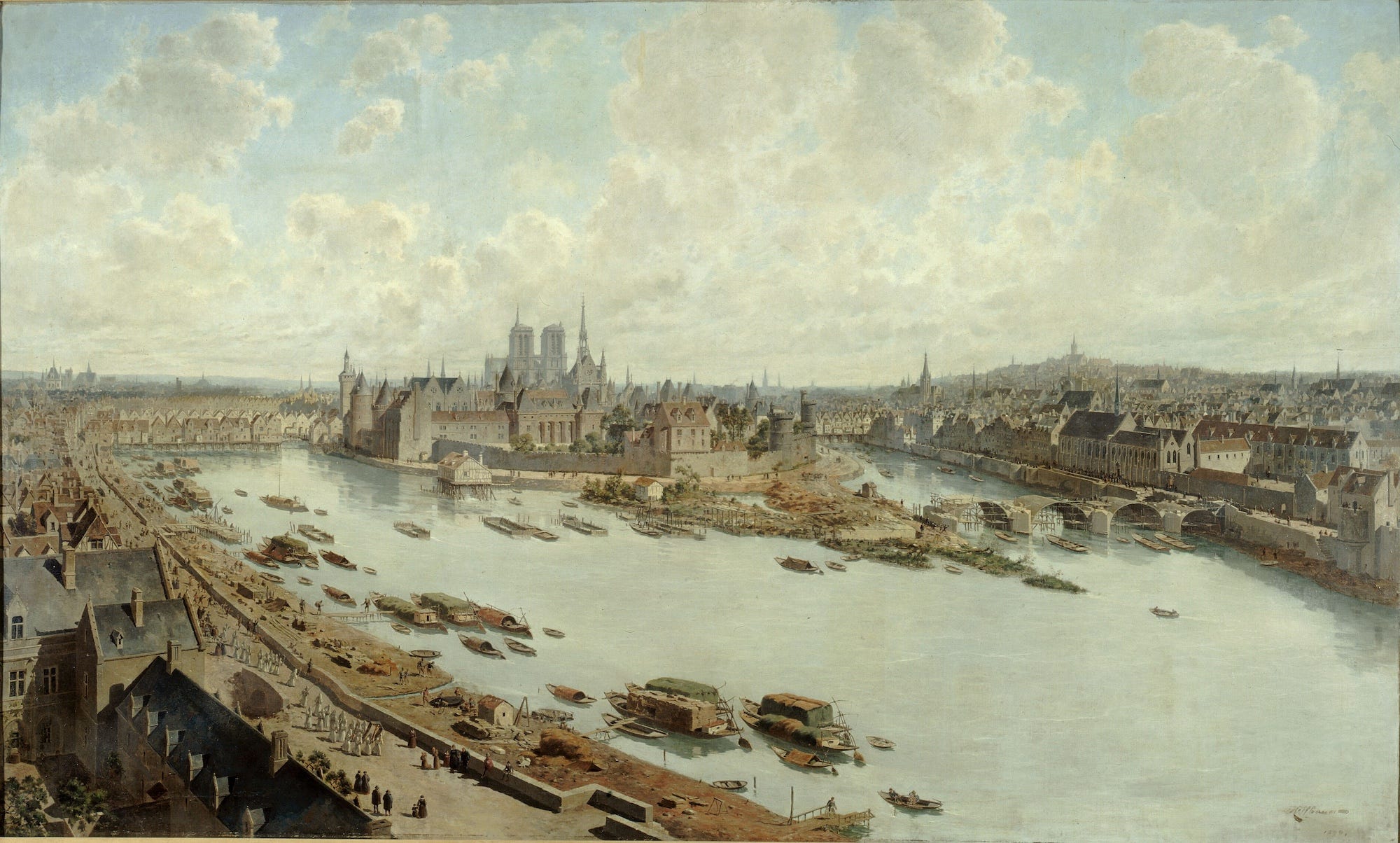
Even if the entire river Seine were to offer itself to a person coming with a pitcher to draw water, the whole of the river could not be drawn up. The amount would be determined by the capacity of the pitcher.
~ Bonaventure, Disputed Questions on the Knowledge of Christ q.7, ad.7
1.
With our overviews of Bonaventure and Hugh of St Victor’s mystical soliloquies complete, and our final destination coming into view, let’s return to the great Seraphic Doctor and the improbably deep epistemological stakes of his dialogue between Soul and Innermost Self. It would be folly to aim for any kind of exhaustive account of Bonaventure’s theory of knowledge, but pinpointing a few issues will, I hope, furnish us the glide path we need to bring this plane in for a landing.
Let’s turn straight to a revealing passage from B’s Soliloquy: A Dialogue on the Four Spiritual Exercises, book 1, section 4, devoted to “How By Divine Goodness the Soul Has Been Restored Through Grace.” Here Innermost Self is introducing the topic to Anima with a string of metaphors that cry out for commentary:
“I now believe that you have somewhat focused the rays of your contemplation (radium contemplationis) so as to understand how you have been formed by nature and how you have been deformed by sin. Now turn the beam of your contemplation so as to see how you have been reformed by grace. You must surely realize that the more perfectly the dark fog of your mind (caligo mentis) has been cleansed in the bath of contrition, the more clearly can be seen the benefits of divine redemption. Sin, according to Augustine, ‘is darkness which dulls the intellect and puts the entire interior of man in the shadows.’ Hence it is necessary that you be all the more solicitous in continually dissipating the shadows of sin from the eyes of your mind (mentales oculi) with the tears of compunction. . . . Now, O soul, that your affections are at peace, turn the beam of your contemplation on how you have been restored by grace through God’s great mercy, lofty wisdom, and wondrous power (I.4.29).”1
Note that nearly every activity of the mind that interests Bonaventure is described here in the language of optics. Building on the ancient association of knowing with seeing, visibility, and luminosity, Innermost Self warns of the mind’s condition when it is “darkened” by sin, when intellect is subsumed by the forbidding “shadows” it casts (peccati tenebra). Active contemplation of truths he likens in contrast to a searchlight that projects a beam or “ray” (radium contemplationis), isolating and illuminating its object(s) from without. Any clear apprehension of the mind’s objects will necessarily be hard won; shadows, distortions, refractions and diffusions first need to be swept away.
To accomplish this the soul’s organs of perception — the “inner senses” — must be cleansed. Dark passions that deform our capacities must be exposed to light and purged; and this can only be done through contrition (per contritionis lavacrum). Only then will the soul’s “rays” of contemplation operate at full power; only then will they begin to touch and lay hold of their true target: eternal things. Liberated from blindness, the soul can now awaken into the light and prepare to behold its ultimate res aeterna, which Bonaventure, appealing to the Psalms (83:10), identifies with the face of Christ, “shining in blinding splendor” (I.4.33; trans. 256).2
2.
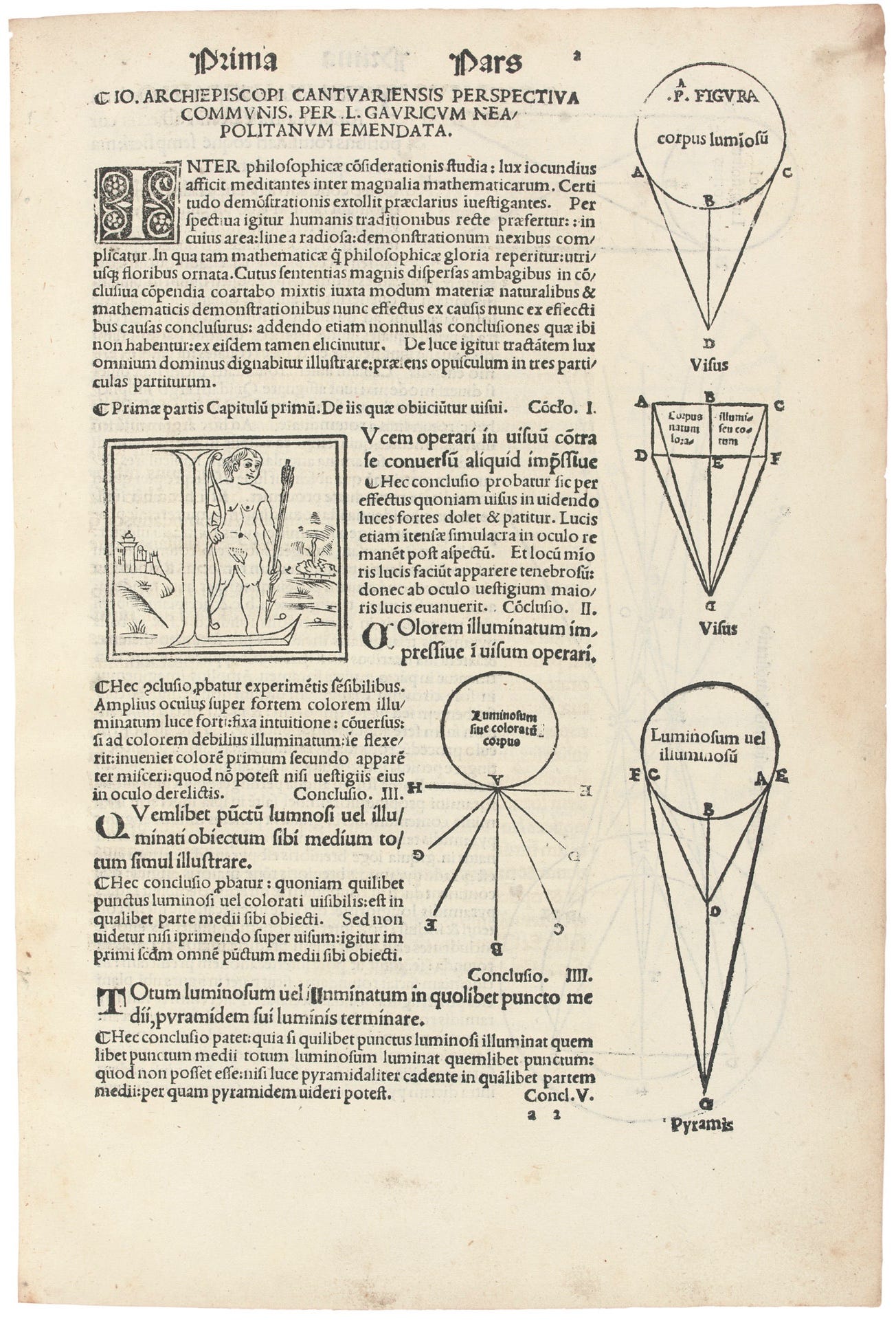
In conceiving the passage from meditative self-attention to mystical knowledge of God, and describing the cognitive process attending it as an illumination powered by beams and rays, Bonventure is not being merely metaphorical. Already by the mid-thirteenth century, optics was a respected science — called perspectiva — with strong epistemological claims, textbooks, lively debates, and leading practitioners.3 Bonaventure was among those authorities, so too his student, the Franciscan John Peckham († 1292); and all of them were avidly reading (in Latin translation) the seven-volume treatise known as the Book of Optics by the Iraqi physicist, mathematician, and astronomer Ibn al-Haytham (known as Alhazen, † c. 1140). Here’s the first page of Peckham’s study, Perspectiva communis, from an early printed edition.
This theoretical-scientific context is essential for seeing what Bonaventure is up to at the practical level, in his works of spiritual instruction. Operating below the surface in the Soliloquy is a whole psychology of “divine illumination” whose technical arguments Bonaventure had already worked out in the scholastic treatise of c. 1253-54, the Quaestiones disputatae de scientia Christi (Disputed Questions on the Knowledge of Christ). Its pedagogical implications he mapped in an high-profile university sermon on Matthew 23:10, Christus unus omnium magister (Christ Our One Teacher). I’ll come back to both works in due time. To keep from getting bogged down here, I’ll state the premise and boil down the rationale of illumination theory as follows.
The premise is pretty simple: the mind regularly requires some kind of supernatural help to carry out cognitive operations, or some part of them, even ordinary ones. As Robert Pasnau puts it, “the theory holds that there are certain kinds of knowledge . . . that we can achieve only with special divine assistance.”4
Now for the rationale. Drawing on a long tradition of Aristotelian empiricism, Bonaventure maintains that the forms of illumination peculiar to external (bodily) vision and those pertaining to internal (intellectual) vision are each, themselves, twofold. Bodily vision, he explains, is the result of two kinds of natural light cooperating with one another: the light of the sun, which illuminates objects from without, and the light of the eye, which is “adapted” from the sun and internalized in order to power vision from within. Together, those two light sources make objects available to the outer and, soon enough, inner senses as well, thus rendering those objects intelligible. Full apprehension only happens when the natural intelligibility of the world’s radiances are matched by the senses which have adapted to them. Cooperation between the two kinds of illumination is key.
Likewise cognition itself occurs through the interaction of two sources of illumination.5 Primary is the light of divine radiance, which according to Augustine establishes the baseline condition by which any and all objects can be grasped by the mind.6 For this inner vision to occur, however — technically speaking, for the impressions gained through the sense organs to be converted by the imagination into mental images — divine light directed toward the mind from the outside must be matched by the intellect’s own, natural, indwelling light.7
Bonaventure calls the faculty guiding this inner illumination the “agent intellect” (intellectus agens).8 Though he’s drawing from Aristotle for the concept itself, the whole theory he finally arrives at is “distinctively Christian, distinctively medieval, and distinctively Augustinian.”9 In the sermon Christ Our One Teacher Bonaventure hunts the premises and the rationale back to several works by the African bishop — Augustine’s Soliloquies (I.8.15), On the Trinity (XII.15.24), and On Free Will (II.14.38) — in order to prove the theorem that “the light of a created intellect does not suffice for a certain comprehension of any thing without the light of the eternal Word.”10
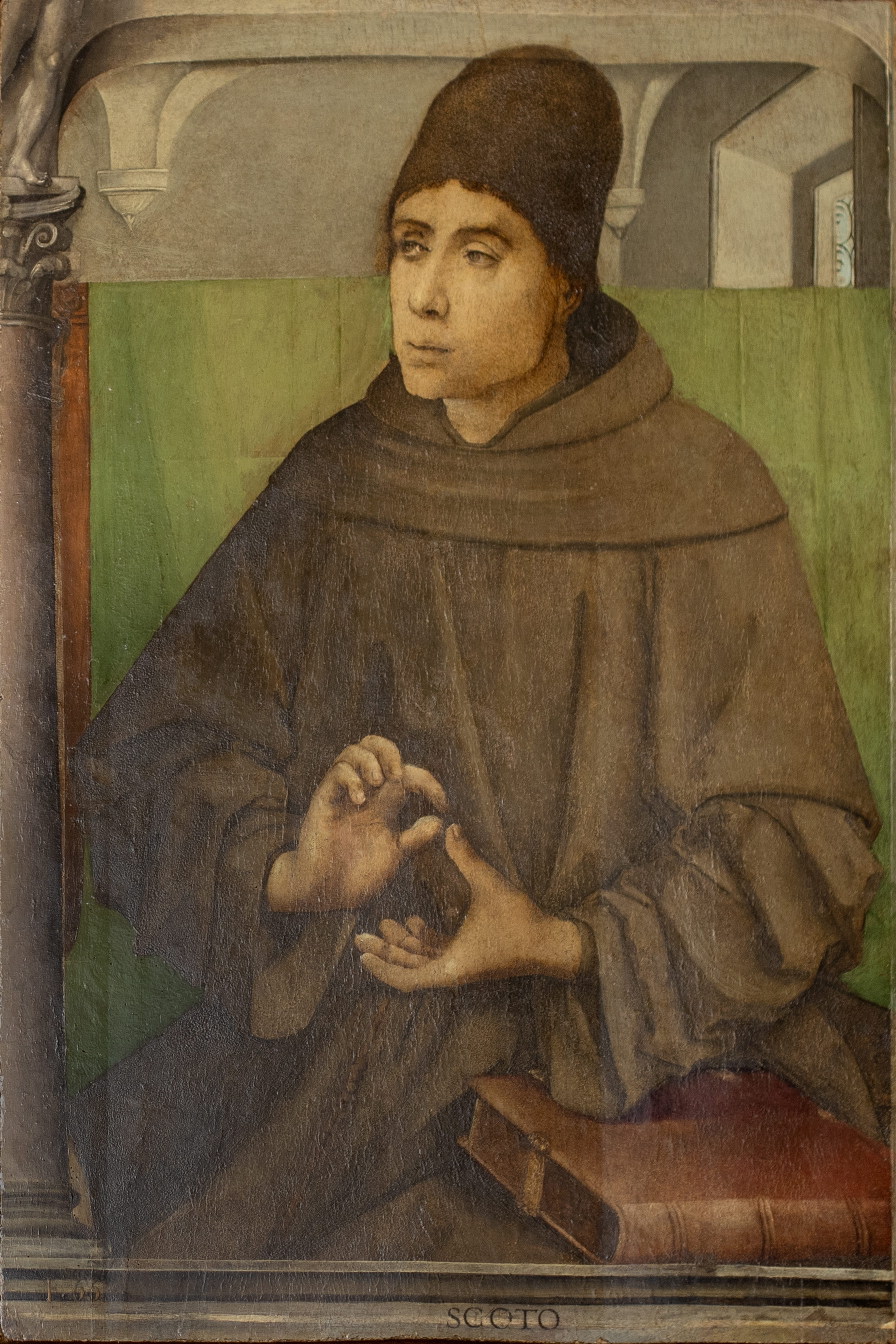
Readers will appreciate how wonky this gets the more you unpack it. The scholarship is vast, as we say in the business, and I won’t go further here. But I would be remiss if I didn’t report on the theory’s scientific fate. After a brief mid-century heyday — very much carried on Bonaventure’s shoulders — the divine illumination theory came under sustained attack, not only by Dominicans but fellow Franciscans such as Peter John Olivi († 1298) and John Duns Scotus († 1308). It was Scotus, called Doctor Subtilis (“the subtle doctor”) but later mocked by Erasmus in the Praise of Folly, who demolished the theory once and for all.11
And yet, when it was still ascendant, Bonaventure’s theory led its adherents to something very compelling for the history of mysticism: the idea that the agent intellect, that invisible and inextinguishable cell powering cognition from within the mind, is nothing less than Christ the Word (logos) and Wisdom (sophia) of God.
3.
One reason Bonaventure, in particular, put so much stock in this theory is because he subscribed to the Aristotelian notion that the whole cognitive process — from sense impressions, through the articulation of mental images by the imagination, to rational intellection — depends on invisible, atom-like “species” (eidola) floating through the air. All perceptible objects disseminate these tiny swarms of representations of themselves; they move outward from the body that produces them, toward the sensing organs, and then further, to the mind. I’m not sure I can make the theory of species any less bizarre than it already sounds, and I just promised not to go further into the wonkiness of it all. But there are two key things about species we should probably have on the table before proceeding.
First of all species, as I’ve tried to convey, are like miniaturized image-likenesses or simulacra, replicas as it were, of the things that produce them (the concept is rooted in the Greek word eídōlon, which can mean “representation” or “figure,” but also phantom, spirit, or ghostly double). Every corporeal, perceptible object sheds species from itself — from its “body” — in response to light; but species are also produced, in the accepted medieval doctrine, when they are activated by the intentional participation (intentio) of the beholder’s vision. This means that the whole visual process — whereby objects connect to sense organs along geometric pathways of light — is one in which essences are “transmitted” to the senses via species.
But that transmission, it’s vital to note, is anything but virtual. According to the classical doctrine, species do their work by actually making a quasi-material impact, an “impression,” on the receptive matrix of the sense organ. Once that happens imagination can step in, take hold of those raw impressions, and process them into images, called phantasmata. These mental images the mind can then use in intellection, memory work, poetic invention or artistic image-making!
A critical upshot of all this is that a relation of similitude is established between the perceiving mind and its objects. Medieval and Renaissance philosophy had two, often interchangeable words for this relation: adaequatio and aequalitas, both of them expressive of the idea that the intellect's assimilation to its objects of apprehension were matters of “adjusting,” “adapting,” and “equalizing” to produce a kind of proportionality between the mind and its knowledge-objects. Thomas Aquinas expressed the epistemological import of adaequatio in his influential formula, veritas est adaequatio rei et intellectus (“Truth is adequation of thing and intellect”).12 All this occurs not as a rigid shackling of the mind to something already fixed in its essence and meaning, but as a “dynamic cognitive process of assimilation” whereby the mind and its objects affect, condition, mold and enfold one another.13
In the Middle Ages the doctrine of species was developed by scholarchs such as Robert Grosseteste († 1253), Roger Bacon († c. 1292), John Peckham, and Peter of Limoges († 1306) — nearly all of them with ties to the university in Paris. By the end of the fifteenth century, regardless of one’s philosophical or spiritual loyalties, it was axiomatic that the cogitating mind was materially altered in some other way by its object “through species” (per speciam). Affect and thought conformed the mind to its sense objects by virtue of a material transfer, becoming grist for imagination’s mill. Which brings us back to the critical role played by agent intellect. Somehow all the raw material of cognition has to become what we call “knowledge.”
4.
So here’s the second big thing to know about species. As Michelle Karnes explains in her superb book, Imagination, Meditation, and Cognition in the Middle Ages, for Bonaventure Christ is species and species are Christ. It is not by coincidence or mere analogy that they both ensure the reliability of the mind’s processing operations and guarantee proportionality between knowing mind and things known. As Bonaventure expresses it, species operate as the key “principle of understanding” (ratio cognoscendi) while the intellect’s self-activity is unfolding.14 And so does Christ. Elsewhere in his writings, Bonaventure even calls Christ prima species, “first Species,” for his role in illuminating knowing at cognition’s every stage.15 The mind secures knowledge of its object as a kind of consummation with the essence of the thing beheld, and Christ the Word, the “light of the world,” is behind it all.
All of this allows Bonaventure to think of those “rays” of contemplation as establishing a concrete mystical connection with God, not merely an affective response. Conformity of oneself to Christ, long understood in the ethical-spiritual sense of discipleship, imitation, empathetic response, and so on, is here matched — indeed, certified —by the conformity of the meditating mind to Christ’s wisdom. As it turns out, then, the exalted mystical sense of empathetic identification with the Suffering Christ (Christus patiens), a mainstay of religious experience imparted to Christian culture above all by the Franciscans, owes a great deal to this kind of scientific understanding of optics, “species,” imagination, agent intellect, and their concerted operations in the whole cognitive process.
Which brings us back to the special kind of certainty that attaches to inner dialogue, meditation, spiritual exercise, and the genre of the soliloquy. It is a certainty all the more efficacious for apprehending God’s love precisely because it arises from the natural capacities of the soul — the human soul, the created soul, the one, according to the medieval scholastics, each and every devotee shares with Christ himself.
5.
For centuries philosophers have struggled mightily with the problem of “how to approach and catch hold of that on the basis of which we think,” as François Jullien put it, that is, how to name and certify “that which is upstream from us or under our feet [as we think], and which as a result we do not think.”16
One solution to the problem, the one that linked Descartes and Augustine across a gulf of more than a millennium, was to insist we can think that “basis,” so long as we are seeking out its reflection in the self-activity of the mind, and so long as that counts as thinking it. Logic and inference can translate this into certainty, but the cognitive operation remains basically reflective. Bonaventure, of course, had different plans. His more technical solution to the problem of certainty was to situate that self-activity of the mind in dialectical relation to both divine knowledge and Christ’s wisdom, with its unique, dual-nature epistemology.
That was the challenge he took up in Disputed Questions on the Knowledge of Christ, composed for a readership of academic colleagues. Structuring the treatise on his favorite symbolic number, seven, Bonaventure sandwiched his core defense of the principal question — i.e., how to explain certitude in human knowledge — between two groupings of three questions each.17 The preceding group explores divine knowledge, and the succeeding group the “wisdom of Christ’s soul,” the same christological problem Hugh of St Victor tackled in the combative counter-treatise he sent to Walter of Montagne (see part 3 of the present essay).
In the Disputed Questions, scientia (knowledge), cognitio (thought) and sapientia (wisdom) form a chain. Establishing the grounds for certitude in scientia is a vexed enterprise, Bonaventure acknowledged. Unlike divine knowledge, which is both perfect and unchanging, human knowing is marked by mutability and instability, making it fallible and inherently uncertain.18 The mind, therefore, must avail itself of whatever access it can get to “eternal reason,” which, as Joshua Benson explains, comes with the power to “impart infallibility to the knower and immutability to the known.”19 The source of eternal reason is precisely Christ’s presence in the soul — but not only his presence, his wisdom as well, for Christ “is himself the origin of all wisdom,” as Bonaventure explains elsewhere.20 Whether he was addressing his university colleagues, mapping the contemplative path for novices, or holding up Jesus as the ideal teacher secular clergymen ought to emulate, Bonaventure doggedly returned to this core idea, “that ultimately all and any certitude is achieved through the light shed on our minds by Eternal Wisdom.”21
What, then, shall we make of the Seraphic Doctor’s matching insistence that, at highest reaches of human knowledge — in the mystic bedchamber where the sponsa unites with the sponsus — all those stabilizing intellectual operations fall away?
With this we arrive at the final question I wish to pose. We’re beginning our descent. Seats and tray-tables should be in their upright positions . . .
6.
In the seventh and last of the “disputed questions” concerning Christ’s knowledge, Bonaventure confronted an apparent contradiction concerning Christ’s human soul and its intrinsic capacity for knowledge of finite and infinite things. Could such a soul reach a “comprehensive” knowledge of all created things, despite the fact that the human soul, by its finite nature, will never comprehend the infinity of things known by the mind of God? After all, Christ is fully God. How to overcome the apparent contradiction?
Hugh, you might recall, resolved the problem to his satisfaction (but not Walter of Montagne’s!) with two interlinked distinctions. First he distinguishes between the knowing in Christ’s soul that springs from “participation” in the wisdom of God and the knowing that comes from “having the fullness so that it possesses the whole” of that wisdom. Second, he insists that, despite never being equal to God on account of being created, Christ’s human soul possessed the capacity for a comprehensive knowledge of things “because the whole of wisdom of God was joined and united to Christ’s soul.” Its nature, he continued, “could not be compared to God, although it received grace without limit, since its passable nature was [combined] with a limitless grace.”22
Passable nature combined with limitless grace? What on earth is the Victorine talking about? Grace is coming to the rescue in Hugh’s christology, so too the hypostatic union (= the doctrine of two natures joined in the one person of Jesus); but they still don’t make all things possible for the god-man. And Bonaventure would agree. The limit is more to the point here than the limitlessness. Benson can help me explain this: “The finite and created soul of Christ can . . . never comprehend the uncreated wisdom ‘which [as Bonaventure writes] is finite from every perspective,’ since the finite can never encompass and limit the finite.”23
Even so, as far as Bonaventure was concerned this hardly resolved the issue. He agreed with Hugh that, despite being elevated by grace to a godlike understanding, true divine knowledge — the comprehensive knowledge of infinite things — was a perfection Christ’s human soul could not attain. Where Bonaventure leaves Hugh behind, on my reading, is in his insistence that, operating in tandem with this hard stop on what knowledge the created soul can attain, there is always in that same soul, at the same time, a continuous drive toward it. What compels the soul to reach so ceaselessly, so irrepressibly, toward an infinite it can never attain? If I’m not entirely mistaken, one word furnishes the answer: desire.
7.
Readers keen to all we’ve said so far about the conditions of knowing in mysticism may have anticipated this answer. Likewise you may have figured out where Bonaventure needed to take the argument. Each finite soul can intuit what lies beyond its natural capacities, and thus yearn for a kind of apprehension of what lies permanently out of reach. This “movement toward” is different than com-prehension, which implies a secure possession of knowledge (and knowledge as a good that is inherently possessable).
Robert Glenn Davis, in his fine book on Bonaventure, The Weight of Love, explains the logic of all this with real incision. “Christ knew the infinity of the expressive exemplar [i.e., God’s mind],” according to Bonaventure (according to Davis), “not with a comprehensive knowledge but by an ‘excessive’ or ‘ecstatic’ knowledge — one that, rather than grasping things completely, is instead ‘taken captive by them’.”24 Bonaventure clarifies this desire-based alternative in the Disputed Questions: “I call this an ecstatic mode of knowledge [excessivum modum cognoscendi] not because the subject exceeds the object, but because the subject is drawn toward an object that exceeds it in a certain ecstatic mode that draws the soul beyond itself.”25
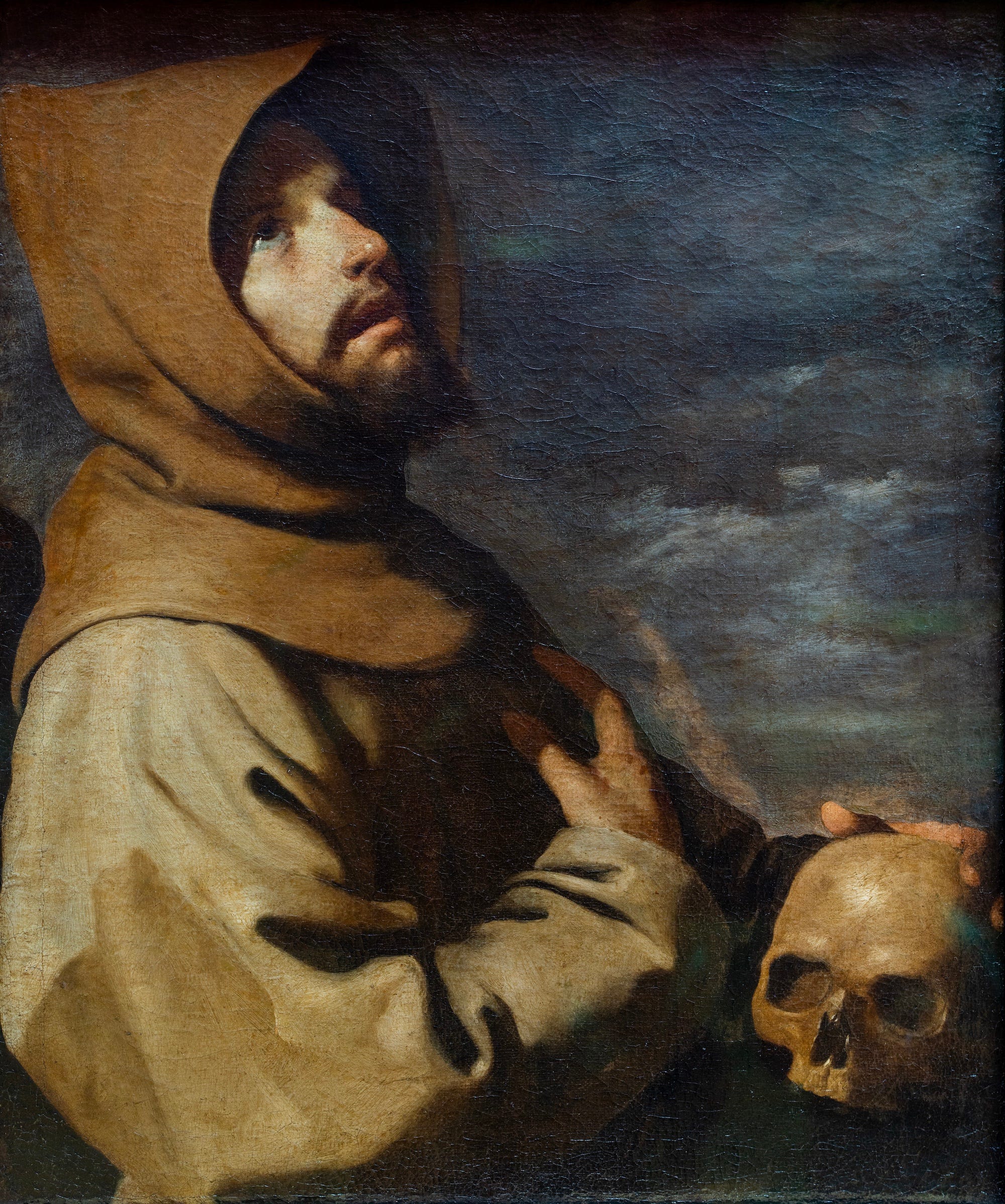
To be drawn beyond oneself: that is the medieval Christian mystic’s aim, for it signals total abandonment to the power of love, the coming union of the bride with her bridegroom, and the return of the desiring soul to God amid a “reciprocating ecstasy,” that cosmic eros which permeates the whole created order. For Bonaventure, Francis of Assisi’s ecstasy (excessus) amid the stigmatization event on Mount Alverna showed the perfection of this “ecstatic mode of knowing,” and fittingly it was Francis and the stigmata that shaped his whole Christian philosophy from end to end.
We’ve landed at our destination. With a few moments remaining before we reach the terminal, deplane, and go our separate ways, let’s ask what light this peculiarly medieval-scholastic model of affective-mystical knowing might shed on our inherited ways of “[catching] hold of that on the basis of which we think” (Jullien). Let’s set the medieval mystical paradigm in dialogue with its seeming opposite, the model with which we began: Descartes’s rationalism.
8.
Descartes had sought for a method — objective, repeatable, reliable — for legitimizing the role a priori knowledge, both true and false, needs to play in our best efforts at introspection. “I know how much we are liable to err in matters that concern us,” he writes in the Discourse on Method, “and also how much the judgments of our friends should be distrusted when they are in our favour. I shall be glad, nevertheless, to reveal in this discourse what paths I have followed, and to represent my life in it as if in a picture, so that everyone may judge it for himself.”26
Commonplace as this seems, Descartes is highlighting something unexpected about the preliminary labor that must accompany all meditation. With each inward turn I should commence by recalling, and exposing myself to, the thinking self’s personal history of doubt. I must review every instance of my own wrong-headedness; face up to my many founderings; register all the false starts that have hindered progress. Ursula Renz’s commentary on this logic animating Descartes’s method is insightful: “To get into the position from which we may reflect upon the necessary truth available through introspection, we have to admit that much of what we initially believe is the result of our credulity rather than our own epistemic power. In other words, we have to acknowledge our exposure to epistemic failure.”27
Point taken!
But we can go further. For medieval epistemology, it seems to me, had always recognized at least two principal forms of epistemic failure, one inescapably bad, one potentially good — indeed transformative. Both were integral to the meditative process albeit in different ways.
On the one hand, and in full agreement with Descartes, medieval perspectives on introspection bore the pained awareness of the self’s infirmities and limits, which reflected not only the soul’s created nature but the many damages inflicted on it by sin. This found its clearest expression in the self’s penitential confrontation with its own failures — moral, affective, cognitive — amid the meditative process (usually at the beginning). Its expression could be at once deeply poetic and effusively performative, as when the mystic Mechthild of Magdeburg willingly crowned herself with the “secret shameful acts that I have committed against God.”
In Christian meditative prayer this embrace of “bad” epistemic failure, as I am calling it, opened that golden pathway to self-knowledge that leads through self-recrimination, contrition, penance, estimations of worthiness, etc. Emotional catharsis and appeals for God’s mercy lay the ground for a ritual undoing of epistemic limits, but only so long as they are not casually jettisoned. Letting the self’s failures remain in plain view, bracing reminders of the soul’s deformity and its need for reformation, has always been part of the process.
A second kind of epistemic failure appears in Bonaventure’s model of “excessive knowledge,” and comes into play when devotion blossoms into mystical love, bringing ecstatic union into view. For the mystic it is a most precious gift. Our modern ideas about the subjective dimensions of Christian mysticism tend to cluster around terms developed by the Rhineland mystics of the later Middle Ages (about whom we’ll hear more in a forthcoming Substack), terms like “detachment” (abgeschiedenheit) and “releasement” (gelassenheit). Both are typically understood to signal the self’s transcendence or abnegation, its departure or disappearance into God (at its root excessus connoted “departure” and “death”).
But as this essay has tried to show, both the mystical soliloquies we’ve examined and mysticism en bloc held open a special place for the soul’s active, ongoing observation of its own capacities and incapacities, the process of gently coaxing them toward the breaking point, toward epistemic failure, for the sake of its own health. If touching the limits of comprehension as a condition of crossing into a transformational knowledge is the end, there must still be a point of departure, and a runway long enough to facilitate flight. Inner dialogue never narrates the total arc of the self’s transcedence; but it could guide the soul in laying the groundwork for its occurrence.
9.
When the soul yearns for the divine, Bonaventure believed, it is seeking repose in God’s love. But when it finds repose there, it is not because it has arrived at secure knowledge, at comprehension. The soul is drawn to the mind of God precisely because it cannot comprehend its plenitude, like drops of water in the River Seine, or grains of sand in the Ganges.28 Rather than struggle for impossible comprehension, the soul, Benson explains, “finds rest in having its own capacities exceeded: the finite craves the infinite as infinite, and precisely because it cannot comprehend it.”29
This is the paradox of certitude in mysticism: it emerges in the experience of registering the plenitude which the self can only ever desire. Returning within oneself, the mind of the devotee sees its own, created nature imperfectly reflected back in that plenitude, doing what its nature permits it to do: embrace epistemic failure as salutary and enlightening. Ecstasy awaits in that embrace which is also a release and a place of repose. Every soul, by its nature, yearns for it. “Nothing is sufficient for the soul,” Bonaventure concludes, “unless it exceeds the soul’s capacity.”30
Soliloquium de quatuor mentalibus exercitiis, in Works of St. Bonaventure, vol. 10: Writings on the Spiritual Life, trans. F. Edward Coughlin O.F.M. (St. Bonaventure, NY: Franciscan Institute, 2006), 211–344, here 253-54; for further references, see part 2 of this miniseries.
Cf. Psalm 83:10: “Behold, O God our protector: and look on the face of thy Christ” (Douay-Rheims).
For perspectiva among its key representatives with connections to Paris, see David C. Lindberg, Theories of Vision from al-Kindi to Kepler (Chicago: University of Chicago Press, 1976), 104-46.
Robert Pasnau, “Divine Illumination,” Stanford Encyclopedia of Philosophy (Fall 2025), ed. Edward N. Zalta & Uri Nodelman (https://plato.stanford.edu/archives/fall2025/entries/illumination/), section 1 (”Orientation”).
Scarpelli, “Bonaventure’s Christocentric Epistemology,” 65-72.
Ibid. 65.
Ibid.
Aristotle’s compact formula for this doctrine appears in De anima (3.7): “So the thinking faculty thinks the forms in mental images.” Put more technically, the term (nous poiêtikos for Aristotle, intellectus agens for medieval scholastics) designates that mechanism of the soul which extracts intelligible data from the mental images (phantasmata), and renders them proportional to intellect’s capacities. For the Aristotelian background, see Christopher Shields, “Aristotle’s Psychology” and “Supplement: The Active Mind of De Anima iii 5,” The Stanford Encyclopedia of Philosophy (Winter 2020 Edition), ed. Edward N. Zalta (accessed at https://plato.stanford.edu/archives/win2020/entries/aristotle-psychology/).
Pasnau, “Divine Illumination,” section 1 (”Orientation”).
Bonaventure, “Christ Our One Teacher,” in The Cambridge Translations of Medieval Philosophical Texts, vol. 3: Mind and Knowledge, ed. Robert Pasnau (Cambridge: Cambridge University Press, 2002), 79-92, at 84-85.
Pasnau, “Divine Illumination,” sections 4-7; also see Ignatius Brady O.F.M., “St. Bonaventure’s Doctrine of Illumination: Reactions Medieval and Modern,” in Bonaventure and Aquinas: Enduring Philosophers, ed. Robert W. Shahan and Francis J. Kovach (Norman, OK: University of Oklahoma Press, 1976), 57-67, at 61-64.
Aquinas, Summa theologica, q. xvi (”Of Truth”), art. 1,3. Scholars often refer to this as Aquinas’s “correspondence theory of truth.” For more on perception and cognition as adequation, with further references, see my The Consolation of Wisdom: Meditation, Dialogue, and Devotion in the Art of Albrecht Dürer and His Contemporaries, chapter 5 (forthcoming).
Jörn Müller, “Adaequatio as Assimilatio: Two Puzzles in Aquinas’ Theory of Truth,” Vivarium 57, no. 3/4 (2019): 341–72, at 345.
Michelle Karnes, Imagination, Meditation, and Cognition in the Middle Ages (Chicago: University of Chicago Press, 2011), 94, with helpful reference to Bonaventure’s works where the phrase is applied to Christ and species respectively.
Itinerarium mentis in Deum 2,8; The Mind’s Road to God: Saint Bonaventure’s Itinerarium mentis in Deum, trans. Philotheus Boehner O.F.M. (Saint Bonaventure, NY: The Franciscan Institute, Saint Bonventure University, 1956), 57.
François Jullien, The Great Image Has No Form: On the Nonobject Through Painting, trans. Jane Marie Todd (Chicago: University of Chicago Press, 2009), xvi.
Throughout Bonaventure’s works the number seven, and seven-fold things, signify repose and contemplation; see Joshua C. Benson, “Structure and Meaning in St. Bonaventure’s Quaestiones disputatae de scientia Christi,“ Franciscan Studies 62 (2004): 67–90, at 72. Itinerarium ch.7, for example, marks “the end of the way of six contemplations . . . like [the] six steps by which [the mind] arrives at peace as at the throne of the true Solomon, where the Man of Peace rests in the peaceful mind as in an inner Jerusalem”; Itinerarium 7,1; The Mind’s Road to God, 97. See also the important contribution by Andreas Speer, “The Certainty and Scope of Knowledge: Bonaventure’s Disputed Questions on the Knowledge of Christ,” Medieval Philosophy and Theology 3 (1993): 35-61.
Benson, “Structure and Meaning,” 75.
Ibid.
Bonaventure, “Christ Our One Teacher,” 80.
Ignatius Brady O.F.M., “St. Bonaventure’s Doctrine of Illumination: Reactions Medieval and Modern,” in Bonaventure and Aquinas: Enduring Philosophers, ed. Robert W. Shahan and Francis J. Kovach (Norman, OK: University of Oklahoma Press, 1976), 57-67, at 61.
Hugh of St Victor, “On the Wisdom of Christ’s Soul,” trans. Joshua Benson, in Victorine Christology: A Selection of Works of Hugh and Achard of St. Victor, and of Robert of Melun, and Excerpts Taken from the Summa Sententiarum, ed. Christopher P. Evans (Turnhout: Brepols, 2019), 85-110, at 103.
Benson, “Structure and Meaning,” 77, with quotation from Bonaventure De scientia Christi, q.6, conclusion; Disputed Questions on the Knowledge of Christ, trans. Zachary Hayes (St. Bonaventure: The Franciscan Institute, 1992), 169.
Robert Glenn Davis, The Weight of Love: Affect, Ecstasy, and Union in the Theology of Bonaventure (New York: Fordham University Press, 2017), 42.
De scientia Christi, q.7, conclusion; Hayes (trans.), Disputed Questions, 187. Cf. Davis, Weight of Love, 43.
René Descartes, Discourse on Method, in The Philosophical Writings of Descartes, 3 vols., ed. and trans. John Cottingham, Robert Stoothoff, and Dugald Murdoch (vols. 1-2), and Anthony Kenney (vol. 3) (Cambridge: Cambridge University Press, 1984-91), 2:17, with emphasis added; quoted in Ursula Renz, “Socratic Self-Knowledge in Early Modern Philosophy,” in Self-Knowledge: A History, ed. U. Renz (New York: Oxford University Press, 2017), 146-63, at 148.
Renz, “Socratic Self-Knowledge,” 148-49.
An epistemic motif that recurs throughout the so-called Diamond Sutra, a Mahayana Buddhist text arguably from around Augustine’s time; see Thich Nhat Hanh, The Diamond That Cuts Through Illusion: Commentaries on the Prajñaparamita Diamond Sutra (Berkeley: Parallax Press, 1992).
Benson, “Structure and Meaning,” 78.
De scientia Christi, q.6, conclusion: “nihil sufficit animae, nisi eius capacitatem execedat”; Hayes (trans.), Disputed Questions, 171.