
Certainty in Excess: Soliloquy, Knowledge, and Mystical Love in Bonaventure and Hugh of St Victor (part 1/4)
Installment #7 in the serial essay, "Presenting the Self: Inner Dialogue and Spiritual Exercise"

And with you is Wisdom who knows your works
and was present when you created the world,
and knows what is pleasing in your eyes
and what is right according to your ordinances.
~ Wisdom 9:9
1.
Cogito ergo sum. I think therefore I am. A maxim that has always left me, um, wondering. Is that all the mind requires to attain certainty of its existence, just thinking? Or does it also require a live perception of the thinking, the “I”’s conscious awareness of itself in the act of doing it? And how much thinking is required? A fleeting moment, just enough to register in perception, or something more like ten minutes? At what point does certainty arise? And which part of me is certified in the process, the self who observes the “I” thinking or the thinking “I” observed by myself? Will any kind of thinking do, or only some kinds of thoughts?
More could be ventured on these questions . . . libraries more. But it’s the reader’s turn to wonder: Why is the author asking these skeptical modern questions at the start of an essay on medieval mysticism, the capacity of the mind for having knowledge of God, and the role inner dialogue can play in gaining it?
2.
Welcome to this 4-part essay, titled “Certainty in Excess.” Our main destination, if you note the full title, will be the century and a half between 1120 and 1274, dates that mark the start of one theologian’s career and the death of a second. I’ll introduce them both shortly. First, in order to get some of the above questions on board, and generate some momentum for the journey, we’re going to need a longer-than-usual runway. I want us to take a broad view of the thinking self and some of the ways it’s been thought about, starting with the age-old question of what we take philosophy itself to be, and what we take it to be good for.
Philosophy has long had to contend with a riven identity, and as a discipline in the human sciences it is still suspended between two, often divergent models. One pertains to philosophy’s enthronement as the theoretical discourse par excellence. This is philosophy as philology, the “love of words” (φιλολογία, philología) that opens onto exegesis, logic, and every kind of idea-building — an identity realized in what some call the “problems and arguments” conception of philosophy. It has long conferred maximum legitimacy on the ancient “love of wisdom” (φιλοσοφία, philosophia) when it envisions its own place among the human sciences.
Astride this self-definition and at times institutionally at odds with it — ask anyone in an academic philosophy department today — is the tradition that looks to philosophy for the means to meet the challenges of human life and strive for higher forms of flourishing. Learning to live in accordance with truth, goodness, spirit, justice, flourishing, etc., these are all ideations of this same concern with philosophy as praxis. By exploring the value of wisdom and the transformational potential of such living-according-to formulas, this model tends to place philología in the service of philosophia, rather than the other way around.1 Historian and philosopher Pierre Hadot (1922-2010), looking to the discipline’s ancient origins, famously termed it “philosophy as a way of life.” Older than the “problems and arguments” model, this ethically inclined, practice-driven striving for wisdom has, over and over, attracted the censure of the theoreticians. In it some would see the sovereign discipline of philosophy, foundation stone of all the human sciences, warping scandalously toward the therapeutic, the spiritual, the mystical — philosophy lending its luster to whatever idiosyncratic fashion we might fancy.
Subscribers to “The Consolation of Wisdom” already know that Hadot’s “way of life” paradigm stands behind much of what I have been up to in this eight-part essay, “Presenting the Self.” Hopefully you, too, are keen on sticking with it a little longer. Without the moorings it provides, we could barely make sense of our main quarry: the long history of inner dialogue, that mode of ethical-spiritual exercise that merges the act of philosophizing in solitude and a therapeutic “concern for oneself” (Michel Foucault’s famous phrase) with the dramatization of those experiences for a reader. Nor is this model of practiced philosophy really all that short on theory! Just ask the Stoics, who roundly rejected the theory-practice divide (for them the three “parts” of philosophy — logic, ethics, and physics — were always intertwined). As we open a new chapter of this history, we’ll meet another generation of thinkers who refused to confine philosophy to either a “theoretical” or a “practical” identity: the scholastic theologians of the High Middle Ages.
3.
Still locking in our coordinates for the journey. Taxiing over to the runway . . . seat belts should be securely fastened.
Fundamental to both of philosophy’s identities is the triplex problem of what that simple formula — ergo sum — actually declares (something do with the truth of being?), what that declaration implies about the thinking self (something like independence of agency?), and what self-transformation thought may be capable of when it’s fully awake to its own powers (something to do with enlightenment?).
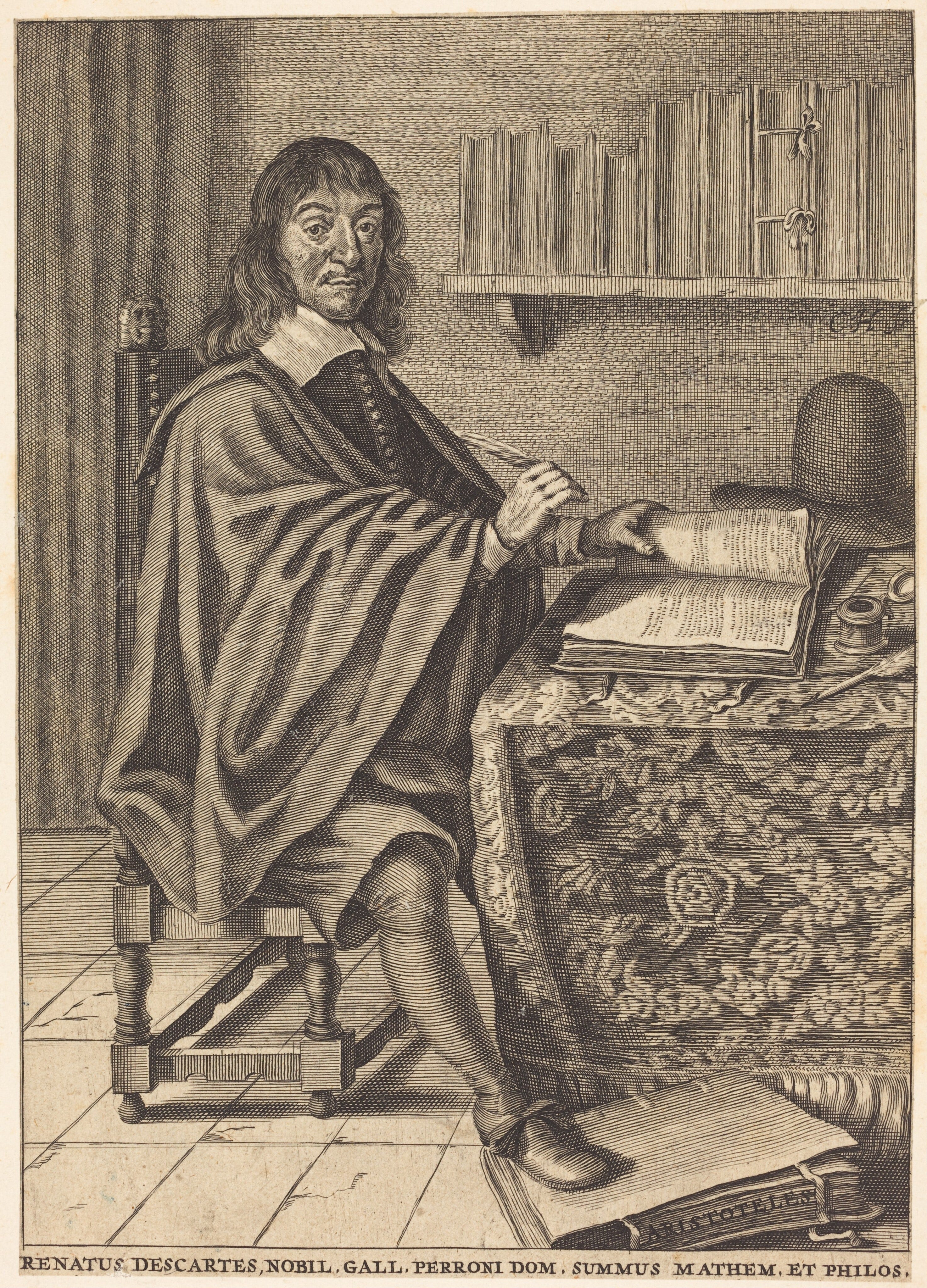
For the line of European rationalist philosophers running from René Descartes (1596-1650), John Locke (1632-1704), and Nicholas Malebranche (1638-1715) to G. W. Leibniz (1646-1716) and David Hume (1711-1776), every moment of consciousness, indeed, every act of perception and thought, held the power to yield fresh evidence of the thinker’s existence. They largely agreed that every perceptual and cognitive act can furnish philosophy with a singularly precise criterion for three defining claims: the claim to be able to identify “truth”; the claim to be able to secure and stabilize knowledge of that truth; and the claim of the “I” to be the prime agency behind those operations of identifying, stabilizing, and experiencing knowledge. Put another way, these thinkers (mostly) agreed that such acts furnish both thought and knowledge with an index of certainty.2
But this is already where the accounts put forward by these early modern thinkers diverge. Whereas Descartes, for instance, made that cognitive indexing a foundation stone of all possible forms of knowing, Locke shied away from claiming that intuitive knowledge of one’s own existence “extends beyond the present moment when I have said experiences.” And neither one saw fit to fashion from his account of the cogito a corresponding metaphysics of the thinking subject.3 For this generation of thinkers, introspection wasn’t necessarily “a glimpse into another ontological realm,” as Richard Rorty once put it.4 That assumption belonged instead to the long tradition of Christian epistemology whose guiding light from late antiquity to the Renaissance was Augustine of Hippo (354-430). Augustine and his intellectual heirs saw no reason to think that the “triumph of the quest for certainty” could ever be at odds with the “quest for wisdom.”5
4.
In a previous installment of this essay we caught a glimpse of an earlier cogito moment, striking in its similarity to Descartes’s more famous one, given the 1200 plus years that separates them. Its author, no surprise, was Augustine. So similar was the African church father’s formulation, in fact, that Descartes could only huff and feign ignorance when asked about the resemblance, saying he would have to “go look it up” at the local library — even though his colleague, the priest and mathematician Marin Mersenne (1588-1648), had pointed it out to him two years earlier.6
Now recall that Augustine arrived at his cogito moment not in a solitary flash of awakening, and not through the kind of ritualized Q&A that he, a seasoned professor of rhetoric, was accustomed to performing in the company of his students. Rather, it occurred amid a solitary spiritual exercise, an inner conversation with an allegorical personification named Ratio (Reason). That, at least, is the conceit of the dialogue he wrote to narrate his experience for others. Implicit in it is the claim that he arrived at his cogito breakthrough via a self-administered, rhetorically self-conscious, spiritual exercise — the kind ancient writers, beginning with the Roman Stoics, called the meditatio.
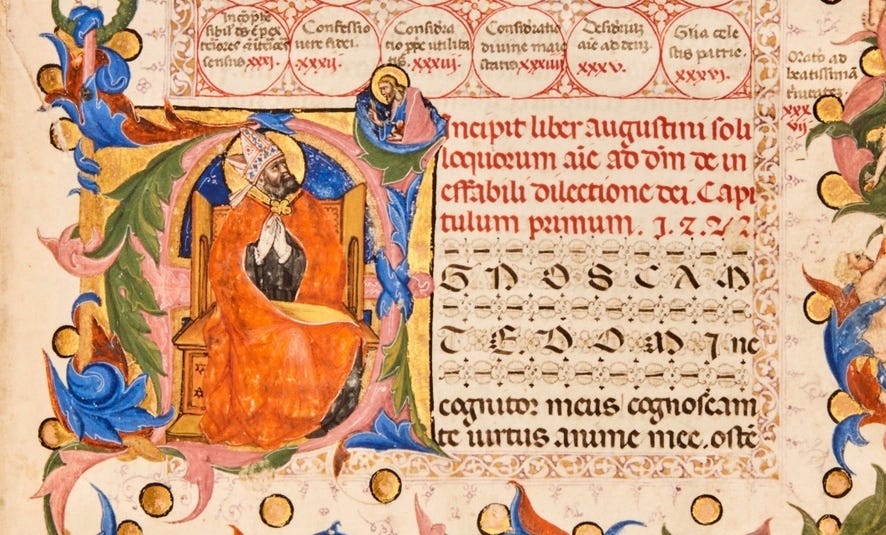
In christianizing this first-person mode of exercise, and recasting it as dialogue between two dimensions of the author’s mind, Augustine also gave it a new name: soliloquium.7 In his hands the genre offered the “inward man” a powerful means for learning to know God and to know himself. For when the mandate of the Christian subject in search of truth is to not to “go outward” but to “return within yourself,”8 the epistemological stakes couldn’t be higher. A new method for arriving at certainty, soliloquy became for Augustine a way of grounding self-knowledge in preparation for knowing God. At the same time, the dramatic-literary form he gave it ensured that inward man’s discovery of an indwelling truth would be performed for the benefit of a reader, who charts his or her own progress by listening in on an otherwise secret conversation. Reminding my own readers of this literary dimension has been a recurring emphasis through these essays on Substack, and it will figure again in all four parts of the present one.
Like Augustine, Descartes’s recognized the potential for meditation to certify the thinking self as an authoritative ground for knowledge. He also recognized the need to pass that certification along to whomever opened his Meditations, a book which promised to furnish humankind with nothing less than the “foundations of marvelous science.” In a brilliant recent account of Descartes’s momentous “turn” toward meditatio-as-method in that eponymous book, Christopher Wild has argued that the French philosopher discovered in meditation “the genre best suited to induce in its reader the self-evidence of the cogito [and] to bring readers to think the cogito for themselves.”9 From this epochal realization philosophy would gain its stature, still current today, as a totalizing theory of knowledge, the discourse that grounds all the other sciences because it stands apart from them — apart, that is, from “all [the] things that mankind is capable of knowing, both for the conduct of life and for the preservation of health and the discovery of all manner of skills.”10
5.
Giving rational intellection a role to play in the process of enlightenment may be what we expect from an early modern philosopher or an ancient professor of rhetoric, but how about the medieval mystic? Here I introduce two scholastic theologians for whom epistemic guarantees of the mind’s grasping for certitude were just as important as they were for Descartes (whom they of course couldn’t have known) and Augustine (whom they couldn’t avoid). Both embraced the meditative soliloquy as a method for putting self-examination in the service of mysticism and its ultimate goal, ecstatic union with the divine, discovering within themselves a transcendent certification point for knowing God (and asking their readers to do the same). To accomplish this, both looked to the interface of God’s infinite love for his creatures and the finite soul’s limit for comprehending that love. Put another way, they looked to the power of desire (desiderium) to bridge the gap between the soul and God, lover and beloved, on the path to mystical union. Desire of this kind, both writers recognized, was affective and cognitive in equal measure.
First up to represent this great reorientation in the history of inner dialogue is Saint Bonaventure (Bonaventura da Bagnoregio, 1221-1274), author, among many works, of the Soliloquium. De quatuor mentalibus exercitiis (Soliloquy: A Dialogue on the Four Spiritual Exercises).
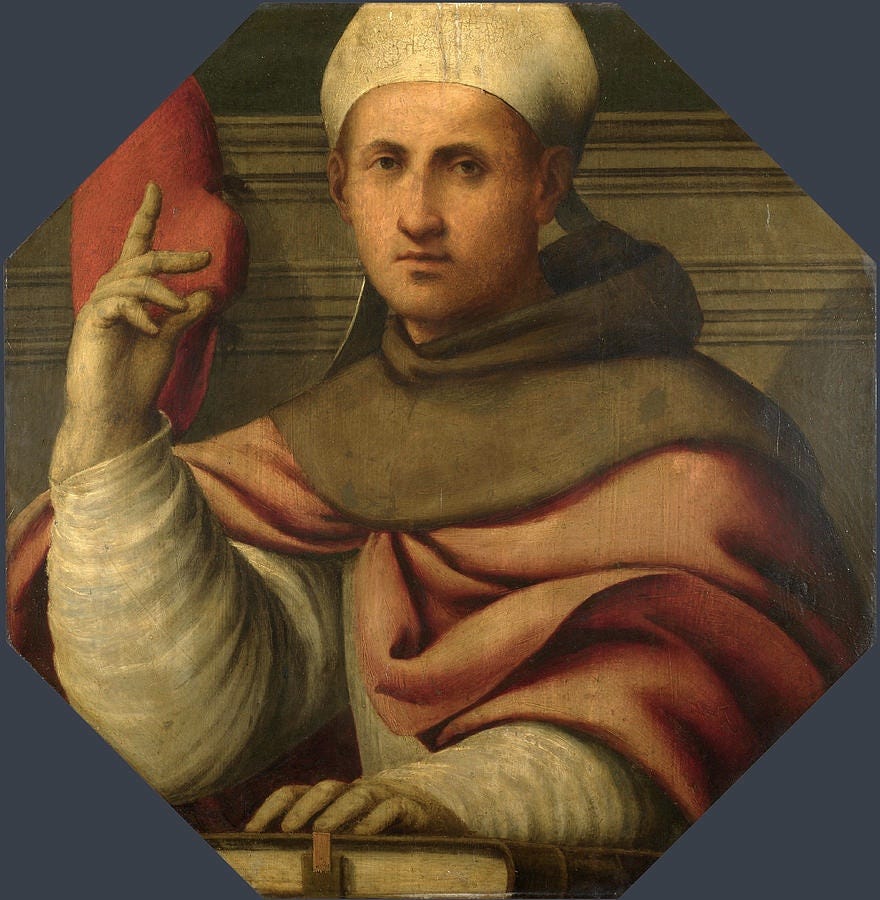
Franciscan friar, scholastic philosopher, theologian, pastoral writer, and church official, Bonaventure studied at the University of Paris from about 1235, earning his magister degrees in both philosophy and theology, then taught there. Later he served as Minister General of the Franciscan order (1257–1274) and somehow also found time to be the bishop of Albano and a cardinal! Revered alongside the Dominican Thomas Aquinas as one of the angelic minds of the Middle Ages, Bonaventure has been known since the first half of the fourteenth century as Doctor Seraphicus (Seraphic Doctor) though he was not formally canonized until 1482.11
Second in order of presentation is the mystical theologian and philosopher Hugh of St Victor (c. 1096-1141), shown here composing his great Didascalicon: De studio legendi, a pedagogical treatise devoted to all the arts, that is, the areas of learning necessary for all human attainment, perfection of the soul, and knowledge of eternal things.
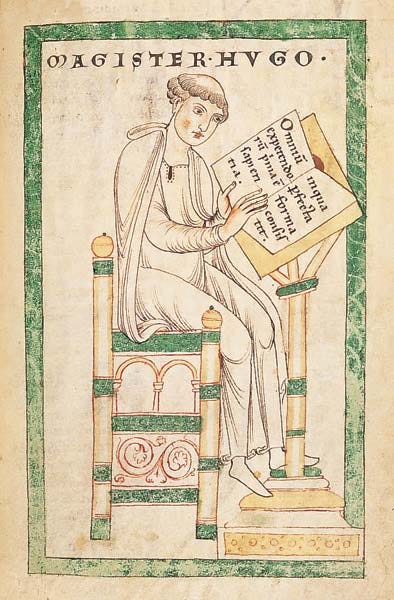
A native of Saxony, Hugh early in life joined the canons regular (aka Augustinian canons) at Saint Pancraz in Hamersleben (13 miles north of Halberstadt) but then transferred to the newly founded Abbey of St Victor in Paris, where he spent his entire career as a theologian and leader of the monastic school. The work we’ll focus on is Hugh’s Soliloquium de arrha animae (Soliloquy on the Betrothal-Gift of the Soul), a mystical dialogue dealing with the soul’s struggle to realize its worthiness in the face of God’s boundless love. It preceded Bonaventure’s Soliloquy by about a century.
Because both authors ventured broadly into biblical exegesis, systematic philosophy, speculative theology, mystical commentary, and pastoral writing, the relationship between human and divine knowledge was for them an inescapable concern. Both, also, understood that relationship to be a matter of genuinely christological import, since for them, as we’ll see, the model for any proper human comprehension of eternal things was the perfect wisdom — the divine wisdom — dwelling in Christ’s (human) soul. Each in his own way thought of this cognition as not only epitomized by but also, in a strong sense, supplied by that divine wisdom, since Christ’s wisdom, according to Bonaventure (who worked it out in greater detail than Hugh), operates within the human mind as a perennial source of illumination.
We will get to all that. While we’re still on the runway, I want to stress that, for both authors, God’s love was more than a necessary motivation for awakening to a clear-sighted vision of eternal things. It also formed the ground and certification point of that knowing.
6.
High medieval scholasticism wasn’t only about taking the rich inheritances of Aristotelian science, logic, rhetoric, and ethics and marrying them to Christian theology, as many textbooks will tell you. Every mode of cognitive and affective experience we talk about today, from sense perception, imagination, and memory to desire and love — yes, our constant companion eros — were major topics for Christian intellectuals.
To speak theologically about love between the eleventh and thirteenth centuries meant engaging a trend in mystical thought that was itself a revival of something ancient: Dionysian mysticism. That odd-sounding term refers to a corpus of speculative writings attributed to Pseudo-Dionysius the Areopagite, an otherwise unidentified mystical neo-platonist writing in late fifth- or early sixth-century Syria. An early medieval legend had pegged him as even more ancient, a discipline of Paul the Apostle, but we know that’s wrong. Inspiring a long tradition of commentary from late antiquity down to the Renaissance, the Areopagite crafted a totalizing metaphysics of spiritual ascent and ultimate union with the divine, grounded in a thoroughly cosmic conception of love. It was God’s “benign yearning (eros) for all that is carried outside himself in the loving care he has for everything” that inspired Him, according to Dionysius, to craft the cosmos, and that primordial process unfolded as paroxysm of erotic energy.
The result was a love-soaked creation whose inhabitants, all God’s creatures, perpetually yearn to return to Him. A “reciprocating ecstasy,” as Denys Turner terms it, permeates the whole created order. “The soul returns to God as to the source from which it flowed; and it returns by means of the same eros to which it returns.”12 For centuries this dynamic of perpetual return shaped not only Christian views of the individual soul’s relation to God, but a whole “ecclesiological narrative of history,” that is, the plotting out of salvation history as a unified arc from the Creation and covenant with Israel to the Incarnation and the realization of the Church, onward to the Kingdom of Heaven.13
Christian neo-platonism wasn’t the only factor that urged medieval intellectuals, celibate monastic writers especially, to describe and celebrate the soul’s love of Christ in the language of eros, sexual union, and the self’s ecstatic return to the source. Later on in this essay we will introduce another critical force: the long tradition of interpreting the biblical Song of Songs as an extended allegory of the virgin soul’s love for, and betrothal to, her Bridegroom.
Here my point is only that both of the thinkers we’re profiling drew extensively from the Corpus areopagiticum and envisioned love as an animating mystery unfolding across the whole hierarchy of created beings. Bonaventure, for his part, called love “the unitive force” behind every corporeal and incorporeal motion in the cosmos, including the motions of the mind.14 Art historians have chased the implications of Dionysian mysticism into every corner of medieval aesthetics, beginning with Gothic design principles, and more recently, the myriad modalities of apophasis — absence, negation, imagelessness, formlessness — that mystical contemplation seems to call for. Fascinating as all this is, it is surely too heavy to take on board a single flight.
7.
A bit of forecasting and outlining now seems to be in order. “Certainty in Excess,” the seventh installment in my 8-part essay “Presenting the Self,” will itself be divided into parts — four to be exact. The scheme is simple. Following this introduction, Part 2 will focus on Bonaventure, and Part 3 on Hugh. Part 4 will then open back out to the christological thinking that united our two soliloquists, while also furnishing Bonaventure a platform for his influential, Augustinian-Aristotelian mashup theory of human cognition, whereby Christ-Wisdom illuminates the process of intellection from within. At that point we’ll be at maximum altitude.
My intent in all this not to say anything particularly new about the theology, however, but to deepen our understanding of the meditative soliloquy as a genre of ethical-spiritual exercise. Both writers sync-ed up the heritage of Augustinian spirituality with premises drawn from Aristotelian natural philosophy — overtly in Bonaventure’s case — to assist the striving soul in dispersing the shadows of sin and despair, the crucial first step in the meditative process. The result is a spiritual pedagogy that pointed the medieval Christian subject toward a “celestial life on earth,” a life where the ardent desire for divine wisdom (sapientia) meant learning how to “taste” (sapere) the “sweetness” of God’s love through meditation, prayer, and higher forms of contemplation. In meditative soliloquy the wisdom teacher, an inner principle of reason personified, guides and instructs the pure soul as “she” (anima) takes those tentative first steps toward God’s loving embrace.
. . . to be continued . . .
For an account of philology’s former reign as “queen of the human sciences,” see James Turner, Philology: The Forgotten Origins of the Modern Humanities (Princeton: Princeton University Press: 2014).
This is different than saying such and such knowledge is “secure and unshakeable by reason,” as ancient epistemology insisted it must be before it figured into the practice of wisdom. For the ancient Stoic definition of knowledge itself as “secure cognition,” see René Brouwer, The Stoic Sage: The Early Stoics on Wisdom, Sagehood, and Socrates (Cambridge: Cambridge University Press, 2014), 30.
Ruth Boeker, “Locke on Being Self to My Self,” in The Self: A History, ed. Patricia Kitcher (New York: Oxford University Press, 2021), 118-44, at 123.
Richard Rorty, Philosophy and the Mirror of Nature (Princeton: Princeton University Press, 1978; repr. 2009), 108.
Rorty, Philosophy, 61.
Christopher J. Wild, Descartes’ Meditative Turn: Cartesian Thought as Spiritual Practice (Stanford: Stanford University Press, 2024), 19.
Along with the dialogue Augustine explicitly titled “Soliloquies,” he employed varieties of soliloquizing in the Confessions, De Civitate Dei, and De Trinitate; see Brian Stock, Augustine’s Inner Dialogue: The Philosophical Soliloquy in Late Antiquity (Cambridge: Cambridge University Press, 2010); idem, “Self, Soliloquy, and Spiritual Exercises in Augustine and Some Later Authors,” The Journal of Religion 91, no. 1 (Jan. 2011): 5-23; and my “Augustine, Soliloquy, and the Hermeneutical Self” (https://mitchmerback.substack.com/p/augustine-soliloquy-and-the-hermeneutical). For the origins and character of the genre before Augustine, Robert J. Newman, “Cotidie meditare. Theory and Practice of the meditatio in Imperial Stoicism,” in Aufstieg und Niedergang der römischen Welt (ANRW) / Rise and Decline of the Roman World: Geschichte und Kultur Roms im Spiegel der neueren Forschung, ed. Hildegard Temporini and Wolfgang Haase (Berlin: De Gruyter, 1989), 1473-1517.
Augustine, De vera religione 39,72; quoted in Charles Taylor, Sources of the Self: The Making of the Modern Identity (Cambridge, MA: Harvard University Press, 1989), 129.
Wild, Descartes’ Meditative Turn, 19.
Descartes, preface to Principia philosophiae; trans. from Wild, Descartes’ Meditative Turn, 7-8. The observation that philosophy earns its stature as a theory of knowledge by distinguishing itself from the sciences it grounds comes from Rorty, Philosophy, 132.
Tim Noone, R. E. Houser, and Joshua Benson, “Bonaventure,” in The Stanford Encyclopedia of Philosophy (Fall 2023), ed. Edward N. Zalta and Uri Nodelman (accessed May 2026 at https://plato.stanford.edu/archives/fall2023/entries/bonaventure/).
Denys Turner, Eros and Allegory: Medieval Exegesis on the Song of Songs (Kalamazoo, MI: Cistercian Publications, 1995), 47-49. For the Dionysian tradition, see Kevin Corrigan and L. Michael Harrington, “Pseudo-Dionysius the Areopagite,” The Stanford Encyclopedia of Philosophy (Summer 2022), ed. Edward N. Zalta and Uri Nodelman, section 5) (accessed May 2026 at https://plato.stanford.edu/archives/sum2023/entries/pseudo-dionysius-areopagite).
Turner, Eros and Allegory, 38.
See Davis, Weight of Love, 65-87.