
Certainty in Excess: Soliloquy, Knowledge, and Mystical Love in Bonaventure and Hugh of St Victor (part 3/4)
Installment #7 in the serial essay, "Presenting the Self: Inner Dialogue and Spiritual Exercise"

Thus it was that the paths of earthlings were set aright,
and men were taught what pleases you,
and were saved by Wisdom.
~ Wisdom 9:18
1.
So far in this four-part miniseries, “Certainty in Excess,” we have situated Saint Bonaventure’s mystical soliloquy (Soliloquium), composed some time in the later 1250s, between Augustine’s late antique innovation and several much later developments in European philosophy’s theory of knowledge. And we’ve brought the discussion to the brink of the Franciscan theologian’s boldest contribution to the philosophy of mind, namely, his theory of human cognition “illuminated” from within by Christ’s wisdom.
Before venturing any further onto that forbidding territory, we need some refreshment. It will come from asking similar questions about inner dialogue’s value for doing spiritual pedagogy — or, let’s say, doing it the way high medieval scholastic philosophers did — in regard to an earlier soliloquy I’ve already had occasion to mention: Hugh of St.Victor’s († 1141) Soliloquium de arrha animae (Soliloquy on the Betrothal-Gift of the Soul).
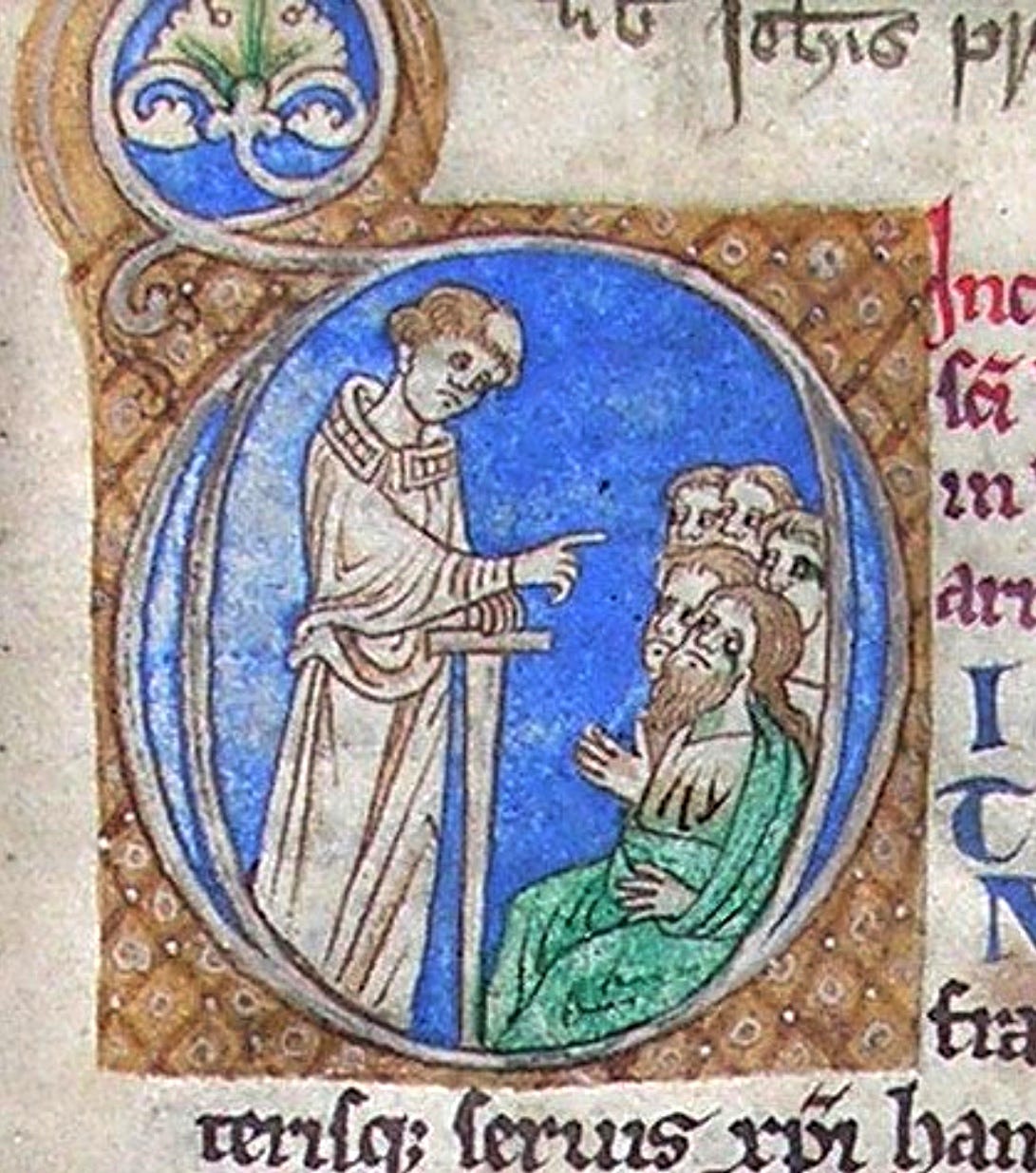
Like Bonaventure’s soliloquy, Hugh’s takes its inspiration from Augustine, and is likewise adept at using personification allegory to map the souls journey to self-knowledge and an experiential knowledge of God’s love. Hugh’s meditative dialogue works from epistemological premises that in some respects align with Bonaventure’s, though others would later give the Franciscan pause. A full-scale comparison of the two works to draw this out would be tedious. What a detour into Hugh’s inner dialogue can accomplish, however, is to deepen our regard for how well the meditative soliloquy, a genre with ancient roots, actively touches and tests the limits of human intellection as both writers saw it. And it can help explain why these operations happen specifically around the matter of God’s love for the soul, the soul’s knowledge of its own nature, and the evidence sought earnestly by the self to certify their truth.
2.
When Hugh’s dialogue opens and the narrator, indicated in the earliest manuscripts only as “H,” speaks “his” opening line, we have already been ushered into a private place of exchange, where nothing is off-limits and truth lies waiting to be uncovered.
“In secret I shall speak to my soul (loquar secreto animae meae) and in friendly conversation I shall obtain what I desire to know. No other person will be admitted, but by ourselves we shall converse in complete candor (sed aperta conscientia). In that way I shall not fear to ask of hidden matters nor will my soul be ashamed to respond with the truth.”1
Are we hearing the author preparing to speak the truth about himself? Is “H” a thinly disguised stand-in, a philosophical actor on the stage of introspection, speaking for Hugh, the much-sought-after theologian from the Abbey of St Victor? Or are we being invited into an imaginative fiction? Can both descriptions ring true together, in concert? Though the experts have weighed in (heavily!) on these questions,2 only the reader can decide. Later I’ll come back to why that’s not a cop-out answer, but a hypothesis worth testing.
From the silent space of discovery opened up on page 1, a single question from H launches the conversation: “Tell me, my soul, what is it you love above all things?” It’s a deceptively simple yet revealing question. After all, the created world brims with beautiful, delightful, and alluring things, each more likely than the last to stoke curiosity and desire, attachment, and ardor. Which of them deserves to be “the single object which alone you would wish to embrace and enjoy forever?” (p13)
Anima confesses that the question has caught her off-guard, confronting her with a dilemma. For nothing she has so far seen has satisfied her desire for a perfect love, and she knows herself to be “unable to love what I have never seen” (14). Responding assuredly, H offers her a way out of the impasse. Instead of waiting in vain for a love-object that is both perfect and visible, ready-made for possession, the soul must learn to discern that perfect love in the things and outer signs that betoken it. Anima’s true Beloved waits in the wings, invisible, yet has already begun lavishing her with gifts! She just needs to recognize them for what they are. It is in and through those gifts — of which there two kinds, some laid out for all his lovers, and some intended for her alone — that she must seek his immeasurable goodness. Acknowledge them as a tokens of his true loveliness. Deduce his intent from the love-pledges already made. Do that, H counsels, and you will comprehend them as the bridegroom’s most earnest down payment (arrha) on the coming betrothal.
All these metaphors have a concrete source and grand tradition behind them, which we’ll come to. For now, let’s just follow the exchange and the logic of H’s counsel to his soul.
3.
Next we hear a refrain that will be familiar to fans of inner dialogue, namely, the insistence that such acts of discernment as H is urging upon Anima can only ever be a first step. More is required than recognizing, passively accepting, and deducing the import of the bridegroom’s gifts. Anima must prove herself worthy of them, and the coming wedding feast. That includes turning from the sinful behavior that threatens to squander her lover’s pledges and adorning herself with every virtue. Out of this regimen of self-beautification and refinement will arise a recognition of self, one that points in two salutary directions at once: toward the soul’s unworthiness (”I was utterly ignorant of the great love my God had for me”) (27) and toward knowledge of the bridegroom’s immeasurable love, a knowledge ready to be experienced and, in a sense, certified, through his gifts. That Anima has been showered with countless gifts from God H has no trouble convincing her:
“After existence, beauty, and life, the senses and intelligence were given to you with the same divine love. . . . How exalted and glorious you have been made, my Soul! What does such attire signify but that He who clothed you has been preparing you as his spouse for his bridal chamber? He knew for what sweet task you were destined and what raiment was needed; therefore He gave what was fitting (24).”
Greater or more valuable things can hardly be imagined. Trouble is, H explains, all of it has gone unthanked and indeed spurned, as if the soul, in her perverse ingratitude, had been expecting something greater.3 No measure of generosity has yet inspired in Anima an ounce of reciprocity or fidelity. And the recriminations keep coming:
“[Consider] what you have done, my Soul. You have deserted your Lover and have squandered your affections on others. You have lost your probity, defiled your beauty, wasted your substance. You have become cheap, debased, impure, hardly worthy any longer of the embraces of your Lover. . . . You have become a harlot; from the excesses of debauchery your breasts have become slack, your brow wrinkled, your cheeks faded, your eyes dull and clouded, your lips pallid, your flesh withered. You have dissipated your strength and even to your lovers you are now hateful (25).”
Hugh’s vividly gynephobic imagery would have struck a deep chord with his mostly male, celibate, clerical and monastic readers, but not only for its lurid physicality. Rhetorical disgust urges this kind of contrition upon all errant souls, though the gendered imagery amplifies the horror of sin. Frank regard of the self — looking into the “mirror” for the sake of self-knowledge — leads at first to contempt for the self, the painful recognition of one’s own sinfulness as a necessary rite of passage.
4.
Female as well as male monastic writers knew few better symbols to serve as the mis-èn-scene of this confrontation with the soul’s ugliness than the bride’s toilet. In her Flowing Light of the Godhead the Beguine mystic Mechthild of Magdeburg († c. 1282 or 1290s), who like Hugh hailed from Saxony, reworked this imagery into an arresting penitential exercise, a vertigious condemnation of self that culminates in a salutary self-recognition:
“I put on the shoes of the precious time that I wasted day after day. I gird myself with the suffering I have caused. Then I put on a cloak of the wickedness of which I am full. I put on my head a crown of secret shameful acts that I have committed against God. After this, I take in my hand the mirror of true knowledge. Then I look at myself and see who I really am.”4
Mystics like Hugh and Mechthild shared an understanding summed up marvelously by Christina van Dyke. “The intimate experience of divine union,” she writes, “is a far cry from self-abasement, and yet it is made possible by the humility that results from self-knowledge.”5
As the dialogue in Hugh’s Soliloquy unfolds, that possibility of union comes into view. Those twin recognitions — of the soul’s abject fallenness and of God’s infinite goodness — instigate a transformation in Anima, a dawning realization of the reflective likeness that binds the lovers, divine and created, to one another. Awakening to their co-presence, Anima voices this realization in a striking plural avowel: “Something wonderful is happening to us” (34).
5.
Written later in life and dedicated to the canons regular of St. Pancraz in Hamersleben, his first home as an Augustinian clergyman, Hugh’s Soliloquium joined a groundswell of religious writings in the twelfth and thirteenth centuries that took their cue from Augustine’s inner dialogue, ensuring the genre’s survival into the later Middle Ages and beyond.6 In his major works of monastic theology and exegesis Hugh proved himself to be without peer. But judging from the number of surviving manuscripts and translations, the Soliloquy became the most popular among his spiritual writings; notably, this renown endured into the later Middle Ages.7
At the risk of going off-topic, mention must be made here of the ingenious “cosmogrammatic” image Hugh invented, and then described, in his ambitious three-volume mystical treatise on Noah’s ark. Yes, you read that correctly: the wooden ark God commanded Noah to build in Genesis 6. Composed between 1125 and 1130, Hugh’s trilogy starts with De arca Noe morali (On the Moral Interpretation of Noah’s Ark), continues with De arca Noe mystica (On the Mystical Interpretation of Noah’s Ark), then wraps up with De vanitate mundi (On the Vanity of the World). To accompany the text and its teachings, Hugh devised an elaborate visual diagram, embellished with allegorical figures and fitted with elaborate captions, all based on the specifications dictated to Noah from on high. Allegedly Hugh had the monumental drawing set up before his brethren as an object for meditations and lectures, but it’s also possible it was never more an ekphrasis, an elaborate rhetorical description of an otherwise fictional work of art.
Art historian Conrad Rudolph’s exacting and audacious study of Hugh’s project is but the most recent attempt to reconstruct what the ark-o-graph might have looked like.8 See for yourself.
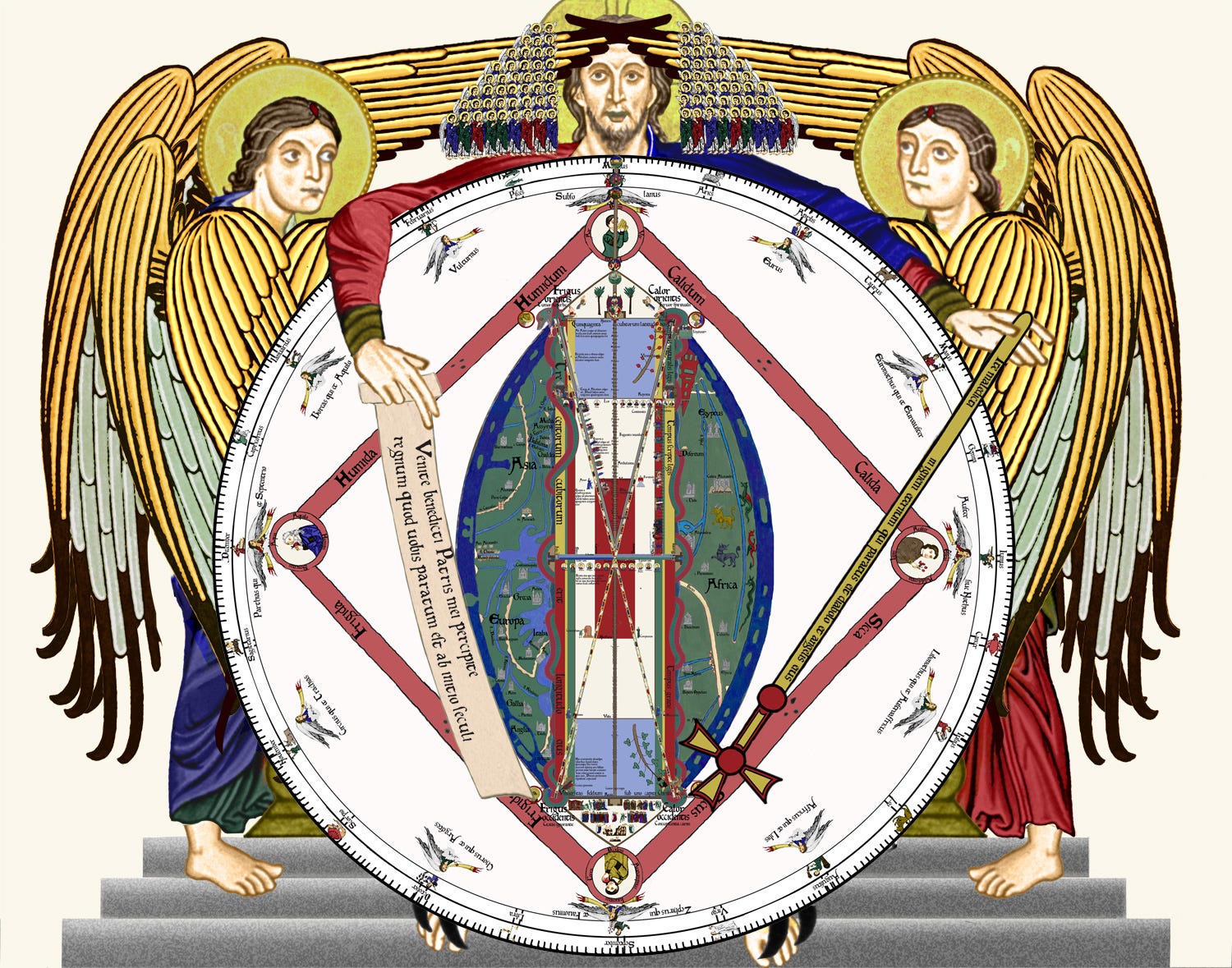
And here’s why I could not resist mentioning it, the feature that has most startled historians of religion about Hugh’s ark-o-graph: the scheme’s resemblance to psychocosmograms of other wisdom traditions, in particular the mandalas of Tibetan Buddhism.9 In a future Substack I hope to revisit some of these questions, think anew about the ark-o-graph’s visual-symbolic structure, and consider its likely meditative function. But we need to get back to Hugh’s soliloquy, Anima’s anxiety over her betrothal-gifts, and the certitude of love. We’ll do it by way of a modest epistemological detour.
6.
Although Hugh seems not to have planned a major work devoted to epistemology per se, he did concern himself with an important, epistemology-adjacent problem that scholastic philosophers would debate vigorously in Bonaventure’s time: the special nature of the knowledge “acquired” by Christ’s human soul and its relation to the Wisdom of God.10 The opportunity to address the question came uninvited, it seems, when the theologian and bishop of Laon, Walter of Mortagne († 1174), posed to Hugh the question he’d apparently been batting around with Arnolph of Séez (later bishop of Lisieux, † 1181), who himself had allegedly heard Hugh discourse on the question, “Whether the soul which divinity assumed in Christ’s person, has completely as much knowledge and wisdom as the divinity has.” In a surviving letter Walter, complaining about the answer reported to him by Arnolph, sanctimoniously tossed the issue back over to Hugh. By way of response, Hugh composed a short treatise, “On the Wisdom of Christ’s Soul,” a brilliant blend of theological argument, effusive expressions of personal affection, and a studied, often hilarious impatience with Walter’s objections.
Hugh’s position, stated as briefly as possible, is this: Christ’s human soul, by nature a created thing, has the full wisdom of God united to it by the grace of the hypostatic union, not by its nature. Explaining what it means for transcendent wisdom to dwell corporeally as a result of the Incarnation, Hugh summarizes the thesis in terms of Christ’s unique divine personhood:
“It means that wisdom has been made one with that soul in which it dwells, and through that soul it has also been made one with that body in which it dwells. How do they become one? Not by change of nature but by a unity of person — one person, not one essence.”11
Why this detour? Well, I admit I’m looking for a convenient vehicle to get us back to Bonaventure before this essay concludes, and I don’t have time to build Noah’s ark. Hugh’s reply to Walter offers a bridge back to those critical issues in what would become a central fixture in the psychology of mysticism Bonaventure (and others) would later build out. I refer to the insistence that, no matter how fulsomely joined with transcendent wisdom a created soul might be, that soul always remained limited, fallible, and profoundly different in nature than the wisdom it “has,” or possesses. Put another way, however much a created soul might appear to participate in God’s wisdom, its capacities could never be adequate to the infinite knowledge of eternal things that was God’s alone.
That conceptualization needs some more context, especially within the frame of the medieval Christian mysticism in which Bonaventure, Hugh, and even grumpy Walter of Montagne were operating. Keep it in mind as we say more about mysticism’s account of human knowing more broadly.
7.
When it comes to modes of knowing, mystics broadly speaking assume a scheme of ascending cognitive levels, often likened to rungs on a ladder. At the lowest of the three rungs is knowledge we achieve in ordinary, mostly self-chosen ways. We read, study, or receive instruction; we see the world with our outer senses or we turn introspective by dint of the inner ones, all because we choose to do so (Hugh and Bonaventure would, of course, prefer we make this choice out of piety rather than vainglory). Knowledge about God, the kind acquired willingly and through conscious assent, regardless how well developed it is — we’re not all theologians after all — belongs in this category.
Closely allied and dependent on the first level is a second, knowledge acquired through discursive reasoning. Here everything that we have gathered, whether through wonder, experience, belief, or reason, and everything we might seek to comprehend, is reviewed and “approved” by the soul’s powers of intellection (typically aided by imagination, sometimes also by memory).
It is from this double grounding in learning and reasoning that the mystic, ignited by desire and fueled by meditation, seeks to rise to something qualitatively different: an immediate apprehension of God. The prepositional distinction here is crucial to note. Knowledge “about” God you can get from ordinary or specialized sources, as you prefer. Recently, for example, I learned a lot by consulting Wikipedia’s entry on “God.”12 That experience wasn’t categorically different from acquiring knowledge about the mating habits of frogs or the boiling point of water. Knowledge of God, according to our medieval authorities, is different. Intrinsically esoteric, hard-won, affective, and often intensely personal, knowledge of God is by definition experiential and, for the contemplative, transformative (the Wikipedia article, to its great credit, doesn’t promise anything like this).
Bonaventure, in his sermon on Matthew 23:10, stitches these essentials of mysticism together into a neat formulation: “Accordingly, it is evident that there are three modes of cognizing: first, though the belief of pious assent; second, through the stability of certain reasoning; third, through the clarity of pure contemplation.”13 We discern and select; then we synthesize and refine; and then, in a critical final phase, we meditate or pray, passing into contemplation (a word rooted in the idea of a consecrated place, or templum, from which we “gaze attentively outward,” contemplari). Leaving all concepts and forms behind, we follow that gaze into the pure light of “unknowing” where the godhead dwells.
8.
As it happens, Bonaventure offered up that neat formula in the context of his sermon on Matthew 23:10, “Christ Our One Teacher,” (to be discussed in part 4 of this essay); and he did so immediately after quoting there Hugh’s theological magnum opus, De sacramentis (On the Sacraments of the Christian Faith, I.10), on the three levels by which cognition shows itself to be “certain and correct.” Speculation on human and divine knowledge, created and uncreated wisdom, represented a major preoccupation of the Victorine school of theology; so too the imperative to chart out contemplative pathways for the fallen soul’s return to God.
But then again, these concerns were hardly exclusive to the canons of St Victor. When Anima, in the opening passages of Hugh’s Soliloquy, laments her inability to recognize God’s love for his creatures in its perceptible forms, thus her power to attain knowledge of the giver, she was also voicing the central concern of a stream of speculative spirituality scholars call Brautmystik, “bridal mysticism.”
One way to think of bridal mysticism is as an elaborate, metaphorical re-imagining of Catholic sacramental piety — the interconnected rites of access, communal and individual, to Christ’s presence — for the sake of union with the divine. That, at least, is my best single-sentence definition. How were the sacraments reimagined? In brief: in terms of love and its rituals. Bridal mysticism was the fruit of a long tradition of Christian exegesis of the biblical Song of Songs, a poem brimming with sensuous beauty, titillating descriptions of love-play, dreams, dialogue. To ensure the Hebrew canticles were read spiritually rather than literally, its wealth of imagery was ruled metaphorical. Further allegorization by Christian writers over the course of many centuries set the stage for the soul’s dramatized movement toward God. We’ve already seen its basic elements in Hugh’s Soliloquy: the individual soul as expectant virgin bride (sponsa), discovering in the love-gifts of the bridegroom (sponsus) a token of their coming consummation.
For some exegetes the Song of Songs ultimately had to be read as figuration of Christ’s mystic marriage to Ecclesia, that is, to the eternal church of all believers. That attitude harkens back to the oldest prophetic traditions of imagining the relationship between God and his people Israel as a marriage requiring fidelity from both parties (but especially the bride).
For our purposes it’s especially important to see that, whether cast in word, image or visionary experience, bridal mysticism unfolds in a rarified meditative space. For it is here that knowledge of God and the soul’s dawning self-knowledge mingle and merge, such that the soul begins to see her own, reflective likeness to the Beloved.14 In one of numerous full-page miniatures prepared for the famous Rothschild Canticles, a small prayerbook of c. 1300 now in New Haven, sponsa ecstatically awaits her lover from beneath the sheets. Peeking out from a cloudburst above, the bridegroom’s descent into the mystical bedchamber signals their consummation and "spiritual marriage" (connubium spirituale).15
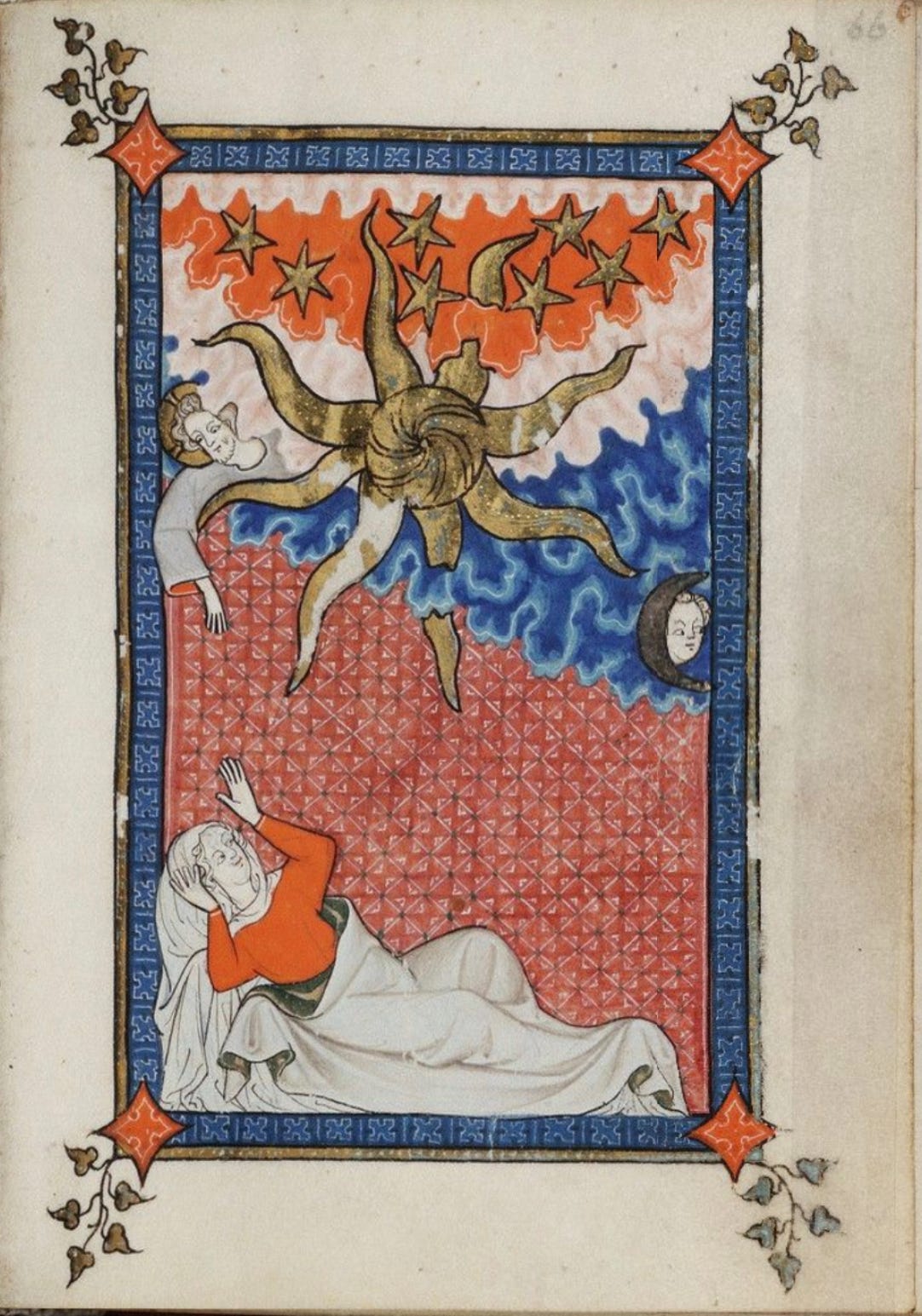
Like other secret spaces in the medieval imaginary, for example, the enclosed garden (hortus conclusus), the draped and perfumed bedchamber served devotional writers and artists as a manipulable stage for the most intimate consummations. At the same time, such secretive places operated as metaphors for the cogitating mind. Contemplative encounter and rhetorical invention needed this kind of inner space, where the most exquisite knowledge — that knowledge of God we’ve spoken of — could be realized at the highest level of affective experience. Aided by poetic imagery, the contemplation of love’s highest rites pointed the soul toward ecstasy.16
9.
Hugh’s alter ego invites readers into a version of this intimate space at the very start of the Soliloquy. Unadorned, it is conjured up by H’s metatextual opening speech (mentioned earlier), where he declares his intention to “speak secretly to my soul . . . with open hearts” (aperta conscientia).17 While there are plenty such rhetorical conceits scattered through the dialogue, this brings us, essentially, to where we’ve been headed all along: inner dialogue in the service of mystical knowledge. Let me highlight the importance of calling it that.
It is always tempting, when talking about spiritual experience, whether from inside or outside the religious tradition in question, to see the myriad forms of figuration — representations, concepts, schema, images —as being at odds with the mystical path toward union. If the Christian mystic (our concern here) must avail herself of a figurative image, she is advised to enlist one from scripture amid the practice of “divine reading” (lectio divina), or from a venerable authority or spiritual guide. In any case, convention dictates that she is to use that figure as no more than a starting point for her meditative labor. As sacred reading (or prayer) proceeds, giving way to contemplative vision, the ascendant mind will — and must — transcend these convenient figurations of the divine. Do away with any concept or outward token that might, by virtue of its material nature, impose limits on what is limitless.
That is the conventional ideal, and it includes even the evanescent mental images we produce during meditation, for these, too, threaten to become fixed forms, idols of the mind, that constrain and distract when the aim is negative apprehension, or “unknowing.” Images have to be driven out for the sake of a pure, contemplative vision.
Such strictures were well-known to Hugh the Victorine canon and Bonaventure the Franciscan monk. Yet it remains striking how, in their respective dialogues, an insistent textuality mediates the criss-crossing encounters of self and soul — and not only by virtue of the many venerable sources the actors keep quoting to one another. To put it differently: These works of spiritual pedagogy, even as they relish the conceit of a single philosophical self’s conversation with himself, the meditative soliloquy, a genre of inner speech unmediated by external voices, is always entangling us in its own mediations. To some degree that’s Reader Response Theory 101; but it’s worth spelling out how it works.
The primary narrated encounter, that between self and soul, unfolds at the level of reasoned inquiry, instruction, and the offer of therapeutic assistance; while a second, the aspirational encounter, the one between the soul and God, gathers strength silently in the background, a spiritual-narrative undercurrent of the pedagogical lessons on display for the reader. We readers follow both encounters. We listen in on the first to learn something of practical use to our own spiritual selves, and imagine our way into the second, as we identify with Anima’s progress toward those twin recognitions we talkd about (= knowledge of self and knowledge of God’s love via his common and singular gifts).
All the while, though, the textual frame we’ve been given at the dialogue’s outset, the authorial conceit of an imaginative-allegorical conversation between two sides of the same human mind, remains in force. Our impulse to identify with the actors is shifted back upon the interrogatory voice of the narrator, H, the self who seeks to awaken “his” soul to the possibility of a salutary self-knowledge. We assent to the spectacle of one philosophical actor — one in whom both “self” and “soul” dwell — “[playing] himself to himself, as his own audience” (as Brian Stock has described inner dialogue), and wonder how fictional it really is, since the very possibility of doing this very thing ourselves, with ourselves and “to” ourselves, has already been made available. Indeed, it’s the whole point of the dialogue. Here’s how Hugh’s dialogue concludes:
“[Anima]: I have one last question to ask you . . . What is that sweet something that sometimes touches me when I remember him and affects me so strongly and pleasantly? Then, somehow, I begin to feel completely alienated from myself . . . Suddenly I am renewed and completely changed, and I begin to experience a wellbeing that is beyond what I can describe. My conscience is joyful, all memory of the misery of past sorrows is forgotten, my mind exults, my understanding grows clear, my heart is illumined, and my desires are joyful. Then I see myself to be elsewhere, I do not know where. . . .
“[H]: “It is truly your Beloved who visits you, but he comes invisibly, in a hidden way, and incomprehensibly. He comes to touch you, not to be seen by you; he comes to move you, not to be grasped by you; he comes not to pour himself completely into you, but to offer you a taste; not to fulfill your desire, but to elicit your affection. He is extending to you certain first fruits of his love; he does not offer full and perfect union. . . . My soul, we have said many things; I ask you after all these: recognize One [only], love One, follow One, lay hold of One, and possess One.
“[Anima]: “This I choose, this I desire, and for this I long with all my heart.”18
10.
One recent commentator on Hugh’s Soliloquy has claimed that the “intimacy of the conversation is manifest in the absence of an outside viewer or observing audience,”19 but it should be clear by now that I think this precisely misses the point. Such an “absence” is always-already undone by the reader or listener, a privileged witness whose very activity confirms the meditation as a rhetorical fiction — “fiction” not in our modern sense of an invented or untrue account of something, but in the ancient sense of fingere, meaning to “form, fashion, mold, or create” — but also as a live possibility for spiritual exercise. In other words, the fashioned-ness of the text makes it no less transformative for its target audience, the invested reader who sees him- or herself as “one who is advancing” (proficiens) toward self-knowledge.
Inner dialogue merges dramatization and exemplarity, then urges a willing submission to the healing efficacy of the word, perceptions of which have nourished the discipline of rhetoric since its ancient origins.20 Here is what makes Hugh’s Soliloquy so much more than a manual for spiritual instruction, a study in mystical psychology, or an autobiographical confession in captivating allegorical dress. Hugh knowingly, I believe, takes on board that great, protean conceit long central to the literary form of the meditatio: the divided self as exemplar and surrogate for those who seek self-knowledge and, through the exercises it enjoins upon us, the chance to attain knowledge of God.
To be continued . . .
Hugh of St Victor, Soliloquy on the Earnest Money of the Soul, trans. Kevin Herbert (Milwaukee: Marquette University Press, 1956), 13. Unless otherwise noted, subsequent quotations are from this edition; I have also consulted the translation by Hugh Feiss (”Soliloquy on the Betrothal-Gift of the Soul”) in On Love: A Selection of Works of Hugh, Adam, Achard, Richard, and Godfrey of St Victor, ed. H. Feiss OSB (Turnhout: Brepols, 2011), 183-232.
As modern translators of the Soliloquium de arrha animae note, early manuscripts label this character alternately as “H,” “Homo,” or “Hugo” (the latter was used in the dialogue’s editio princeps); Hugh Feiss, in his translation notes, makes a good case for avoiding both the impersonality of “Homo” and the misleading autobiographical implications of “Hugo,” settling instead on “self,” despite its overburdened contemporary associations; see Feiss (ed.), On Love, 229n6. Migne, in Patrologia Latina 176 (cols. 951-970D), names the interlocutors “Homo” and “Anima.” Given the apparent reference to Hugh (the author) in the Confessio toward the end of the dialogue, I have opted to use the unresolved ambiguity of “H” on its own. Pronouns for this agentive voice in what follows are gendered male, partly in recognition of “Hugo” and “Homo” as the equally likely meanings behind “H,” and partly for the intended assymetry with his opposite, anima, who the dialogue’s author figures female for reasons beyond grammatical gender.
Reason’s role in overthrowing ingratitude was a leitmotif in ancient discourses on the gift, the most enduring being Seneca’s De beneficiis. From Book 2: “But if you assess nature’s generosity properly you will have to admit that you have been her darling” (29.5); Lucius Annaeus Seneca, On Benefits, trans. Miriam T. Griffin and Brad Inwood (Chicago: University of Chicago Press, 2011), 52-53.
Das fließende Licht der Gottheit, book 6; Mechthild of Magdeburg, The Flowing Light of the Godhead, trans. Frank Tobin (Mahwah: Paulist Press, 1998), 226-27; and quoted in Christina Van Dyke, A Hidden Wisdom: Medieval Contemplatives on Self-Knowledge, Reason, Love, Persons, and Immortality (Oxford: Oxford University Press, 2022), 39.
Van Dyke, A Hidden Wisdom, 50.
The list assembled by Feiss (trans.), “Soliloquy,” 190-191n17, includes works by Adam Scott, the Pseudo-Bernard and Pseudo-Augustine, Bonaventure, and a variety of mystical works associated with the Brethren of the Common Life, to which I would add the late 14th-century Soliloquium cum Deo ignitum by Gerlac Petersen, a canon regular from Deventer; trans. Monialis (London: Longmans, Green and Co., 1920).
Feiss (trans.), “Soliloquy,” 188 (translator’s introduction).
Conrad Rudolph, The Mystic Ark: Hugh of Saint Victor, Art, and Thought In the Twelfth Century (New York: Cambridge University Press, 2014), with numerous variations, details, and isolated elements illustrated throughout. Based on its presumed location and function, Rudolph’s reconstruction is meant to be scaled to 3.632 meters (11 feet, 11 inches) and a width of 4.623 meters (15 feet, 2 inches). Nearly all of the figurative and script elements Rudolph includes are montaged from the Hortus deliciarum of Herrad of Landesberg, a manuscript produced at the convent of Hohenburg between 1176 and 1196.
Grover A. Zinn, “Mandala Symbolism and Use in the Mysticism of Hugh of St. Victor,” History of Religions 12, no. 4 (May 1973): 317-41, at 334.
See Laurence S. Vaughan, The Acquired Knowledge of Christ According to the Theologians of the 12th and 13th Centuries (Rome: Schola Typographica Missionaria Dominiciana apud S. Sixtum, 1957).
Hugh of St Victor, “On the Wisdom of Christ’s Soul,” trans. Joshua Benson, in Victorine Christology: A Selection of Works of Hugh and Achard of St. Victor, and of Robert of Melun, and Excerpts Taken from the Summa Sententiarum, ed. Christopher P. Evans (Turnhout: Brepols, 2019), 85-110, at 101 (hereafter “On the Wisdom”). This edition also includes Walter of Montagne’s letter to Hugh and Hugh’s rescriptum (dedication letter) to Walter.
Accessed June 6, 2026, at https://en.wikipedia.org/wiki/God.
Bonaventure, “Christ Our One Teacher,” in The Cambridge Translations of Medieval Philosophical Texts, vol. 3: Mind and Knowledge, ed. Robert Pasnau (Cambridge: Cambridge University Press, 2002), 79-92, at 80.
My remarks here dovetail with Ritva Palmén’s observations about the “dialogical formation of the self” in Hugh’s Soliloquy, while other aspects of her account of the dialogue’s “recognition relations,” which engages with Hegel, Ricouer, Charles Taylor, and Axel Honneth, strike me as superfluous; see Ritva Palmén, “I Need to Be Individually Loved, Lord, Let Me Recognize Your Gift!”: The Gifts of Love in the Soliloquy of Hugh of Saint Victor (d. 1141),” Speculum 95, no. 1 (Jan. 2020): 167-185.
The unrivaled treatment remains Jeffrey F. Hamburger, The Rothschild Canticles: Art and Mysticism in Flanders and the Rhineland circa 1300 (New Haven: Yale University Press, 1990).
On the bedchamber and related enclosures as a spaces for cognition and rhetorical invention, there is no better guide than Mary J. Carruthers, The Craft of Thought: Meditation, Rhetoric, and the Making of Images, 400-1200 (New York, 1998).
Here I rely on Feiss (trans.), “Soliloquy,” 205.
Feiss (trans.), “Soliloquy,” 227-28.
Palmén, “Gifts of Love,” 169.
See Pedro Laín Entralgo, The Therapy of the Word in Classical Antiquity, trans. L. J. Rather and John M. Sharp (New Haven: Yale University Press, 1970).